Alphabet Inc. — Form 424B2, filed with the SEC, February 2026 · open the full filing ↗
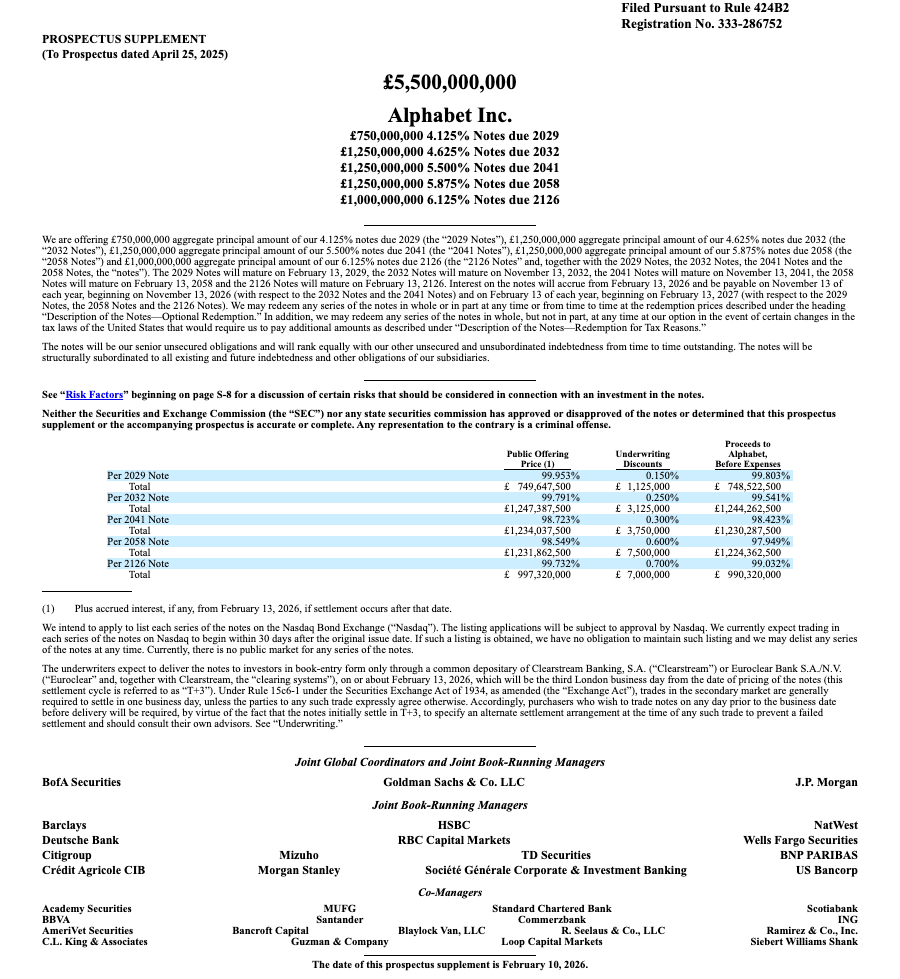
Cover page shown. Most terms are here; open the full filing for the rest.
Columbia MBA · Capital Markets
September 11, 2026
Scene 0 — Framing
Read · 30 seconds
Today's activity · February 2026
The AI data-center buildout is now being financed in the bond market. In February 2026, Google's parent Alphabet raised $20 billion in dollars and £5.5 billion in pounds in a single offering. Tucked into the sterling portion is a bond that does not mature until 2126, one hundred years from today.
Would you lend to them?
Estimated time: 20 minutes
Scene 1 — Extraction
Verifiable answers
This is the actual form Alphabet filed with the SEC when it sold these bonds. Every public bond sale in the United States requires one, and the exact terms live here. Use the form to fill in the missing items below.
Alphabet Inc. — Form 424B2, filed with the SEC, February 2026 · open the full filing ↗
Cover page shown. Most terms are here; open the full filing for the rest.
| Issuer | Alphabet Inc. |
|---|---|
| Maturity | Currently selected |
| Coupon | |
| Issue size | |
| Price to public | 99.732% |
| Interest paid | |
| Minimum purchase | £100,000 |
| Use of proceeds |
On screen, in words
“This is the actual form Alphabet filed with the SEC when it sold these bonds. Every public bond sale in the United States requires one, and the exact terms live here. Use the form to fill in the missing items below.”
Scene 2 — The financing decision
After the table is complete
Completed extraction
| Issuer | Alphabet Inc. |
|---|---|
| Maturity | February 13, 2126 |
| Coupon | 6.125% |
| Issue size | £1,000,000,000 |
| Price to public | 99.732% |
| Interest paid | Annually on February 13, beginning February 13, 2027 |
| Minimum purchase | £100,000 |
| Use of proceeds | General corporate purposes, which may include repayment of debt |
CAiSEY says
Asked one at a time, after each response. No model answers appear on screen.
“In your own words: what is this money for?”
Follow-up
“The filing says general corporate purposes. The news says AI data centers. Which do you believe, and why would the filing be vague?”
Question 2
“Alphabet holds roughly $100 billion in cash and generates more every quarter. Why borrow at all?”
Question 3
“What other ways could Alphabet finance the data-center build?”
Scene 3 — Duration intuition
Guess → Reveal → Apply
Beat 1 · Pick a range
Duration
The weighted-average time until you receive a bond's cash flows. It also measures price sensitivity: a duration of 14 means a 1 percentage point rise in rates lowers the price by roughly 14 percent.
Benchmark: a 30-year bond has a duration of about 14.
Example selection shown
Cash flows a century away are so heavily discounted that they barely add to the average.
What happens to the price of this bond? What happens to the price of the 30-year?
Duration comparison
CAiSEY says
The reveal stays hidden until a range is chosen.
“What do you think the duration of this bond is? Pick a range.”
After the guess
“This 100-year bond: about 17. Cash flows a century away are so heavily discounted that they barely add to the average.”
Then apply it
“Now suppose the Fed suddenly raises rates by one percentage point. What happens to the price of this bond? What happens to the price of the 30-year?”
Scene 4 — Who should own this bond?
Open judgment
Beat 1 · Retail investor
Assume you have the wealth and clear the eligibility bar. The question is whether you would want it.
Ten times oversubscribed.
Insurers and pension funds hold liabilities that stretch decades. Long assets match long liabilities.
CAiSEY says
“As a retail investor, would you buy this bond? Assume you have the wealth and clear the eligibility bar.”
After the retail answer
“Which institutions might want it, and why?”
Then · Whole-class discussion
“Let's hear three anonymized answers. Where do you agree, and where would you push back?”