Finance Questions for DeFi
January 2022
The developments in DeFi, or decentralized finance, are much quicker than accompanied advances in academic discourse. In this post, I organize some questions based on my preliminary readings that will help us keep up with the fast-changing landscape. I plan on updating this list as the landscape evolves.
Resources
Here’s a list of resources that I found to be quite useful for thinking about crypto:
- A DeFi crash course for normies: Crypto markets since 2017 (January 2022)
- Stephen Diehl’s blog
- The Crypto Syllabus
- Crypto Risk Assessments
- Blockchain Consensus Mechanisms: A Primer for Supervisors
- Crypto-assets and Decentralized Finance: A Primer (May 2022)
- Chapter on Cryptoeconomics by Cowen and Tabarrok (May 2022)
Topic: Design Conundrums
- Contracts, except for the simplest ones, are generally incomplete. In fact, this is an observation so strong that it led to a whole theory of incomplete contracts that sought to structure corporate finance theory from ground up. Viewed under this lens, the basic tenet of smart contracts seems fragile, not to mention the occasional errors associated with programming in general. How the DeFi community deals with the inherent incompleteness of contracts seems to be an interesting development to follow.
- One popular argument often found in the DeFi arena is that when the constituents of a network (say Facebook) are the main value creators for the platform, then they should also be capturing some of the benefits. What this argument seems to omit, however, is that it costs too much to implement. Understanding which industries are more amenable to such ownership seems first-order for contemplating welfare implications.
- JP Koning makes a key point that the holders of cryptocurrencies do not internalize the costs of decentralization, which delivers a false sense that a decentralized currency comes at a free cost. This feature is due to the fact that the issuance schedule of the cryptocurrency is public and therefore built into the price.
- The “token effect” is often explained in contrast to the “network effect.” A network benefits from network effects, and you should join a network that a lot of people already use. But for crypto, you should join a network that a lot of people will use in the future. How important is this distinction for understanding both the dynamics within the network as well as its stability through time?
- There is a crypto-equivalent of a principal-agent problem in which the code underlying the technology is inevitably developed by only one or a few groups. What mechanisms can be implemented to discipline the behavior of the creators of the platform?
Topic: Risks in Crypto
- There is a practice called “yield farming,” which refers to lending and staking one’s cryptocurrency to earn high yields. Basically, people are rewarded for providing liquidity. Interestingly, the yields are quite high as you can see in the snapshot below:
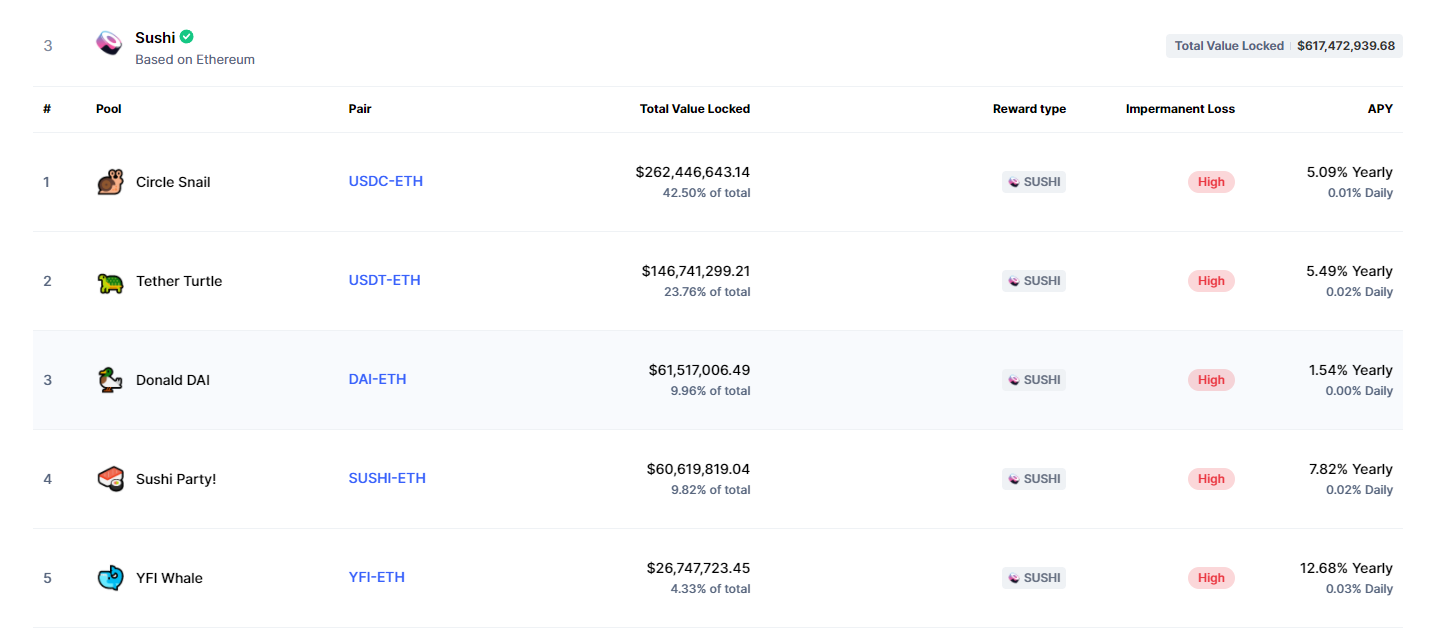 What explains this wide variation in yields? Is the usual risk associated with crypto — regulatory risk, cyber threats, etc — sufficiently high to explain the high average yield? I lack the knowledge of institutional details to enumerate all possibilities, but thinking about the nature of the risks involved in these “farming” and how they are priced by investors seems interesting.
Topic: Macro Implications
- Stablecoins, which are cryptocurrencies designed to peg their value to an official currency, come in many varieties. This report describes the four most basic types of stablecoins: fiat-collateralized, commodity-collateralized, crypto-collateralized, and non-collateralized. Understanding the pros and cons of each mechanism, as well as how they may co-exist alongside CDBCs, is already an active area of research and seems to have non-trivial welfare implications. See Cong and Mayer (2022) for one example.
- Another question concerns the optimal design of stablecoins. A recent paper by Liao and Caramichael (2022) argue that a narrow bank approach for digital currencies can lead to disintermediation of traditional banking.
- One channel through which crypto may affect financial stability is the wealth effect of the crypto market. Recent research highlights the large magnitude of the wealth effect coming for the stock market and the real estate market. Does the crypto market exhibit a similar level of marginal propensity to consume?