Elon's Natural Experiment
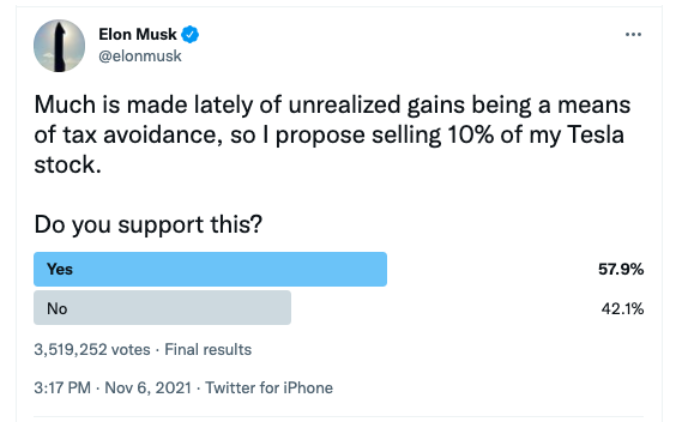
On November 6th, 2021, Elon Musk tweeted that he would sell 10% of his stake in Tesla following the outcome of a Twitter poll. In this post, I use this episode as a lens into theories of asset demand and their role for prices. I have benefited greatly from discussions with Aditya Chaudhry.
The Natural Experiment
Here’s Elon’s tweet and the outcome of the poll:
The price dropped from 1,221.79 on Friday 4pm to 1,148.41 on the next Monday 9:30am, which is a negative realized return of around 6%:
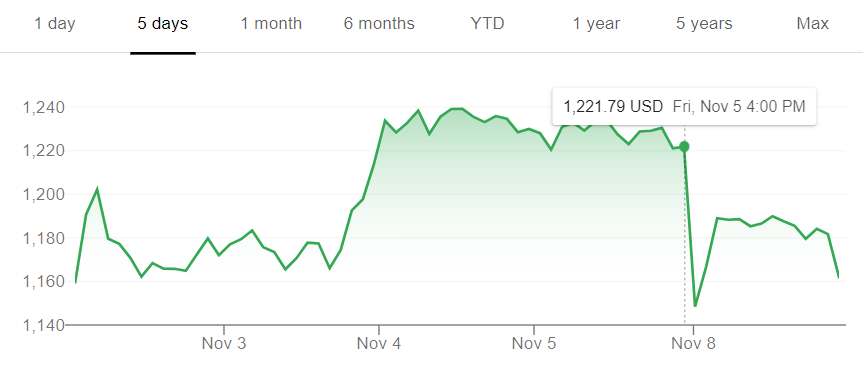
How do we make sense of this pattern, assuming no material fundamental information (large enough to cause the price drop) about Tesla was released over the weekend?
Importance of Risk Aversion and Volatility
An obvious answer to the question above is the following. If you are an investor and you think price is going to drop tomorrow, it makes sense to sell today. While intuitive, this logic does not work if the investor is risk-neutral.
To make this more concrete, suppose the stock price is $1 and you think Elon is going to sell the stocks with some probability \(p>0\) over the next 3 days, which is your investment horizon. Then your payoffs are:
- If you sell today, you earn $1.
- If you don’t sell today, then you earn $1 minus Elon’s price impact with probability \(p\) and $1 with probability \(1-p\).
Since your expected profit is greater when you sell today, you choose to exit.
Now consider the situation with Tesla. The stock price is 6% lower than what it used to be, and Elon’s sell order has not materialized yet. So the current holder of Tesla faces the same conundrum as above — selling today strictly dominates not selling it today. So he should choose to sell.
In fact, extending this logic implies that even with the slightest hint of a demand shock in the future, which reduces the stock price with a positive probability, everyone should try to get out until the shock materializes. Of course, we do not see this in the data, so why is this the case?
One important component that is missing is that of volatility. Suppose the stock price has some noise term \(\epsilon_{it}\) with mean zero. Then the payoffs are:
- If you sell today, you earn $1 + \(\epsilon_{it}\)
- If you don’t sell today, then you earn $1 minus Elon’s price impact + \(\epsilon_{it}\) with probability \(p\) and $1 + \(\epsilon_{it}\) with probability \(1-p\).
What \(\epsilon_{it}\) does is that it allows the price to become higher even when Elon’s price impact materializes. We still run into problems, however, because in expectation the second option is strictly dominated.
This is when risk aversion comes in, i.e. the utility function is concave. Then by making \(\epsilon_{it}\) have sufficient weight in the right end of its distribution, one can show that the strict dominance no longer holds.
Thankfully, risk aversion and volatility are essential ingredients in any asset pricing model. But contemplating what happens with risk neutral investors with Tesla’s example is a good reminder of the necessity of these modeling elements.
Preemptive Price Impact
The above post was about why the selling pressure that materialized on the day of the announcement stops at some point, instead of investors exiting completely. Now let’s talk about why there is price impact today in the first place if one expects a flow to happen \(T\) days from now.
Gabaix and Koijen (2021) develop a model in which flows in and out of the stock market have large impacts on prices. Much of the paper is devoted to obtaining quantitative estimates of the “aggregate demand elasticity,” but their stylized model proves very useful for understanding this Elon shock.
A key theorem from their model is the following:
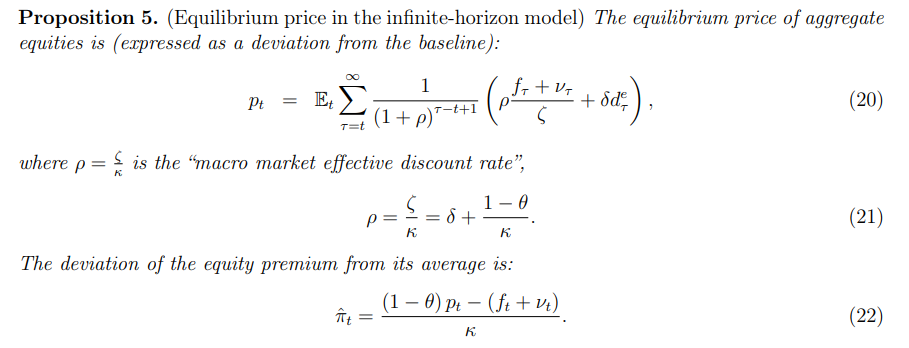
A key element is that the price discounts future dividends at rate \(\rho\) which is grater than \(\delta\). And it applies a higher discount rate when it is less sensitive to the equity premium (\(\kappa\)).
This model predicts that if it is announced today \((t=0)\) that a permanent inflow \(f_T\) will happen at time \(T>0\), then the price impact for any date \(t\in[0,T]\) is given as
\[p_t = \frac{1}{(1+\rho)^{T-t}} \frac{f_T}{\zeta}\]where \(\rho\) is the “effective discount rate” that is increasing in how fixed the investor mandate is, and \(\zeta\) is the aggregate elasticity of demand for stocks. Therefore, in Elon’s case, the price gradually drifts downward after the initial jump, and at \(t=T\), the price becomes \(p_T = f_T / \zeta\).
Uncertainty around Elon’s Execution Date
In the tweet, Elon did not specify when the selling would happen. Naturally, this introduces uncertainty in to what the short-term expected return will be. If Elon had announced the date, would the price impact have been higher or lower than 6%?
One effect of the uncertainty is that it reduces asset demand. In a simple mean-variance framework, for example, portfolio weight in risky asset demand is decreasing in \(\sigma^2\), and since the timing of the selling affects the expected return over a given time horizon, uncertainty reduces asset demand and the prices as well. So this channel would predict that prices we observed are lower than the counterfactual price in which Elon specified the date of his sale.
Other Discussion Questions
Matt Levine has some discussion questions related to this event as well, which I list below. Please check out his original post for a more detailed discussion.
- How binding is this Twitter announcement? Since he had a plan he put in place in September to sell the shares in advance, do they count towards the shares that he has to sell because of his Twitter poll? Can anyone file a claim of damages against him?
- Why did he do the poll as the CEO? If Musk had just started selling on Monday, pursuant to his prearranged plan, without saying anything to anyone, presumably the stock price would have stayed high and he’d have sold on Monday in the $1,220 area. Is this a much better disclosure practice than that of other CEOs?