Institutional Details and History for Finance PhDs
August 2021
Contents
In this post, I summarize key institutional details and historical episodes that come up consistently in seminars and job talks. For both empirical and theoretical research in finance, a solid understanding of these seems useful.
Monetary Policy & Fiscal Policy
- Conduct of Monetary Policy
- New Zealand is the first country to set an inflation target. The 2% target was somewhat ad hoc, but gradually other countries adopted this 2% target.
- Japan implemented the first quantitative easing to fight domestic deflation in the early 2000s. The Fed was next to follow in the aftermath of the subprime mortgage crisis.
- The ECB and the Fed have learned a great deal from each other. ECB now publishes meeting summaries analogous to the Fed’s minutes, while the Fed chair now holds a post-policy-meeting press conference, something the ECB has done from the start.
- In the past, the Fed influenced the federal funds rate through open market operations. When reserves were scarce, the Fed could influence the FFR with small changes in the supply of reserves by conducting open market operations that would shift the supply curve to the right (increasing reserves) or left (decreasing reserves).
- The Fed has now adopted a new strategy. With ample reserves in the banking system, the Fed now sets a target range for the FFR rather than setting a single target. It now also pays interest on both required reserves and excess reserves. Finally, an institute using the Overnight Reverse Repo Facility can deposit reserves at the Fed overnight and earn interest on the deposit, which essentially serves as a floor for the FFR.
- The FOMC meets eight times a year to formulate monetary policy (by law it must meet at least four times) and determine other Federal Reserve policies. Though all 19 members attend the meetings and take part in the discussion, at any given time only 12 of the FOMC have policy voting rights. All seven governors have a vote; the president of the New York Fed is a permanent voting member; and four of the remaining eleven Fed presidents vote for one year on a rotating basis.
- This article summarizes the change in the Fed’s framework quite nicely.
- Communication of Monetary Policy
- FOMC meetings have been tape-recorded since the 1970s to prepare minutes. Initially, committee members believed that these tapes were erased afterward. In October 1993, following pressure from politicians, Alan Greenspan discovered and revealed that before being erased the tapes had, in fact, been transcribed and stored in archives all along. The Fed quickly agreed to publish all past transcripts and, a short time later, extended that policy to cover all future transcripts with a five-year lag.
- Government Debt
- Governments in good standing generally don’t repay debt because they refinance it. Unlike households who must eventually retire their debt, a government can in principle refinance its debt indefinitely.
Financial Stability
- Terminology
- The stability of the financial system refers to its ability to deliver essential services (like credit intermediation, risk mitigation, and payments) even after it has been hit by an adverse event.
- Macroprudential policy is designed to deal with problems emanating from the financial system that affect the real economy and that will not be addressed adequately by microprudential regulators or corrected naturally by private agents acting in their own interest,
- Policies to Ensure Stability
- Bank capital\(\neq\)bank reserves. Reserves are cash deposits at the central bank and vaulted currency. Therefore, the reserve requirement is about liquidity — it is designed to protect against runs. Capital is (essentially) assets minus liabilities of the bank. Therefore, capital requirements are about solvency — they are designed to absorb losses on loans and other investments. Reserves are accounted on the asset side of the balance sheet, while capital resides in the equity section of the balance sheet.
- Systematically Important Financial Institution (SIFI) refers to any financial institution that may pose a serious risk to the economy if it were to collapse.
- Stress tests are nothing fancy. You first figure out how much capital a bank has and then compute how much capital it would have left after going through adverse scenarios and paying out to shareholders. If the remaining amount is less than the required amount, then the bank fails the tests and cannot raise its dividend or do buybacks.
- Fannie Mae and Freddie Mac are two entities established by the government to boost the housing market. Fannie Mae stands for the Federal National Mortgage Association. Freddie Mac is the Federal Home Loan Mortgage Corporation. ‘ The primary difference between Freddie Mac and Fannie Mae is where they source their mortgages from. Fannie Mae buys mortgages from larger, commercial banks, while Freddie Mac buys them from much smaller banks.
Markets
- Stock Market
- Payment for order flow is actually not that nefarious. It’s the practice of wholesale market makers (like Citadel) paying brokers (typically retail brokers) for their clients’ order flow. All three parties win because (1) market makers are able to trade profitably against client orders on average, (2) clients may benefit from reduced trading costs, and (3) retail brokers earn the spread between the two.
- You can still trade after the stock market closes. So the stock market doesn’t really “close.” Usually the bid-ask spreads are greater and liquidity lower. There is also potential adverse selection if you’re a retail trader.
- Delisted companies to the OTC market. Liquidity in the OTC market is incredibly thin — 25% of OTC equities see no volume on 95% of trading days. Since there is no central exchange, a network of broker dealers execute trades bilaterally and post quotes on OTC link ATS.
- Clearinghouses are a response to credit risk in stock trading. Stock trading is when a buyer and a seller agree to a trade on the stock exchange and then, two days later, the buyer delivers the money and the seller delivers the shares. To solve the credit risk, clearinghouses essentially guarantee every trade. The main stock clearinghouse is the National Securities Clearing Corp. (NSCC); the main options one is the Options Clearing Corp. (OCC). Brokers are required to keep cash at the clearinghouses to guarantee their obligations to settle trades.
- Treasury Market
- Form of Treasury securities, which are sold through auctions, depends on their maturity. Those with maturity of 1 year or less are T-bills, which bear no interest. Treasury also issues 2-, 3-, 5-, and 10-year notes on a regular cycle. Finally, Treasury also issues interest-bearing negotiable bonds with maturity at issue of 30-years.
- Corporate Bonds Market
- Insurance companies are major investors in corporate bond markets, but their share has been declining. The large groups that have been growing are mutual funds and the foreign sector.
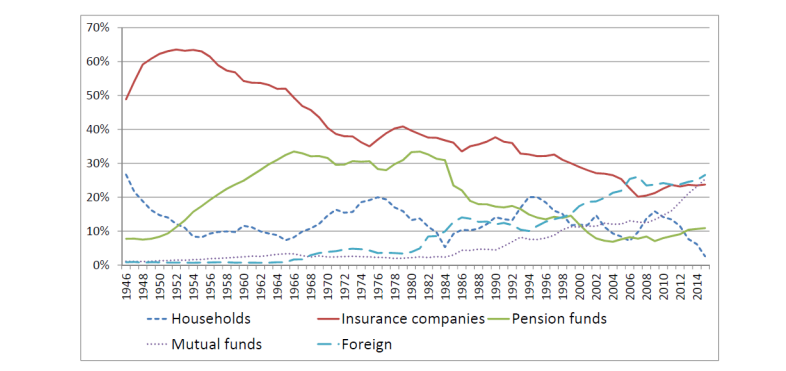
- Insurance companies are major investors in corporate bond markets, but their share has been declining. The large groups that have been growing are mutual funds and the foreign sector.
- Muni Bonds Market
- Income received from interest payments on munis is usually tax-exempt at the federal, state, and local level. Therefore, bonds are generally held by high-net-worth individuals who can benefit most from this exemption .The yields on municipal bonds are generally lower than a corporate bond with similar credit risk because investors require a lower return due to the tax-exemptions, and indeed the purpose of these exemptions is to give access to cheaper credit for municipal governments.
- There are two types of bonds issued by state and local governments: general obligation (GO) and revenue bonds. GO bonds are backed by the full faith and credit of the underlying government. On the other hand, revenue bonds are tied to specific capital projects, the proceeds from which are then used to make the interest payments.
- Repo Market
- Repo is a short-term secured loan. Institutions with a lot of securities that can serve as good collateral can borrow cheaply from parties with lots of spare cash (e.g. monetary market mutual funds).
- In September 2019, the repo rate spiked to almost 10% intra-day, which led even financial institutions with excess cash refuse to lend. It reflects two sources of demand: quarterly corporate taxes due date and the settlement date for previously-auctioned Treasury securities.
- Others
- LIBOR is an interest-rate with a scandalous history. interest-rate average calculated from estimates submitted by the leading banks in London. Because of the nature of its calculation, bankers at several major institutions were caught colluding with each other to manipulate this rate. As a result of the scandal, the Fed and the regulators in the UK will replace LIBOR with the Secured Overnight Financing Rate (SOFR) which is based on the short-term loans observed in the repo market.
Investments
- Mutual Funds
- Mutual funds typically keep cash reserves to cover investor redemptions so that they will not be forced to liquidate portfolio securities at inopportune times.
- Swing pricing refers to adjusting a mutual fund’s net asset value to pass trading costs along to shareholders who are buying or selling shares. It discourages shareholders from rushing to be to the first to sell their shares in a crisis because they receive a price that reflects the impact of their decision to sell.
- Hedge Funds
- Long-Term Capital Management (LTCM) is one of the worst blowup in history. When Russia defaulted on its debt in August 1998, LTCM was holding a significant position in Russian government bonds. Because LTCM was highly levered, it sustained massive losses which approached $4 billion. Fearing that the collapse of LTCM would precipitate a large crisis, the government bailed them out in coordination with other major banks.
- Market Makers
- Wholesalers refer to firms like Citadel Securities, G1X Execution Services LLC, Two Sigma Securities LLC, Virtu Financial Inc., Wolverine Securities, etc who pay the sellers more for their shares than the exchange offers, charges the buyers less for shares than the exchange offers, and keeps the remaining spread for themselves.
- Private Equity & Venture Capital
- Limited partners (LPs) provide capital, and general partners (GPs) do the work. GPs are responsible for deal-sourcing, managing portfolio companies, and exits. GPs call capital from LPs at the time of the deal, and they return capital to LPs after fees upon exit.
- Private equity has elements of a regulatory arbitrage, since buying PE allows you to avoid the following problems in seeking leveraged equity returns:
- Whenever a tax exempt entity, such as an endowment, earns income using debt financing, that income must be reported to the Internal Revenue Service as unrelated business taxable income (UBTI), which is a massive hassle to monitor and report.
- A law called the Uniform Prudent Management of Institutional Funds Act contains vague language about limits on the amount of leverage charities can use in their investments. If a charity does want to use leverage, it has to hire a lawyer to figure out if it is in bounds, and it might not be.
- IRS rules say that if a non-profit has a substantial amount of UBTI, that entity loses its tax-exempt status (this is to prevent charities from simply buying operating businesses and competing unfairly with taxpaying ones)
Key Regulations and Episodes
- Paul Volcker is the former chair of the Fed who ended the high levels of inflation during the 1970s and early 1980s. He raised interest rates to 20% and drove the economy into a deep recession to eliminate the expectation that prices would keep rising rapidly.
- Sarbanes-Oxley Act of 2002 established sweeping auditing and financial regulations of public companies. It came in response to financial scandals in the early 2000s involving publicly traded companies such as Enron Corporation, Tyco International plc, and WorldCom.
- 2010 Dodd-Frank Act is a law passed in response to the financial crisis. It led to the establishment of the Financial Stability Oversight Council (FSOC) and the Consumer Financial Protection Bureau (CFPB). Another key component is the Volcker Rule which restricts the ways banks an invest, limits speculative trading, and eliminates proprietary trading.
- Taper Tantrum in 2013: In May 2013, then-Fed Chairman Ben Bernanke suggested that the central bank was just considering scaling back its bond purchases. The yields on US treasuries shot up, but the stock market made only temporary declines. There was prolonged stress in emerging markets with sharp depreciation in currencies and reversal of capital inflows into countries like Brazil, India, Indonesia, Turkey, and South Africa.
Taxes
- A 1031 exchange is a real estate investing tool that allows real estate investors to defer capital gains if they roll their profits into another real estate investment (abstracting many complications).
Corporate World
- Bankruptcy
- Chapter 11 grants the company an opportunity to restructure its debts and continue operating, whereas Chapter 7 is the straight liquidation and distribution of the sale proceeds to creditors.
- Personal bankruptcy comes in two flavors: Chapter 7 and 13. In Chapter 7 (liquidation), the court stops creditors from collecting payments or repossessing assets. In Chapter 13 (reorganization), you are allowed to switch to a more affordable repayment plan. One main advantage of Chapter 13 is that it offers individuals an opportunity to save their homes from foreclosure.
- Business bankruptcy comes in three flavors: Chapter 7, 11, and 13. Chapter 13 can be used for small business bankruptcy. Chapter 7 is when everything goes. Chapter 11 (business reorganization) buys you time through reorganization and is most often used by large entities.
- Financing
- Large firms with good credit ratings sell commercial paper. A handful of investment banking firms account for most of the placements of commercial paper. While the maximum maturity is 270 days, the average maturity for commercial paper is 45 days.
- Buybacks and dividends are more or less the same, except that buybacks are more tax-efficient. If a company pays a dividend, every shareholder gets cash and has to pay taxes on it. If a company buys back stock, shareholders who don’t sell pay no taxes (but benefit because their ownership interest in the company is increased); shareholders who do sell pay taxes, but even they don’t pay taxes on the full amount of cash received (just their gain over what they paid for the stock).
- Oversight
- Corporate law is a matter of state law. Securities law is federal — if companies lie about their securities to raise money they get in federal trouble — but corporate law, and in particular the fiduciary duties of directors to shareholders, is state law. Delaware law, mostly, because big U.S. public companies are mostly incorporated in Delaware, and Delaware has specialized judges who are good at business law.
Key Numbers
- The total market capitalization of the US stock market is around $40 trillion as of 2020.
- US GDP in 2020 is about $20 trillion.
- The average public company trades 126% of its market capitalization every year; a billion-dollar public company will do about $1.26 billion of stock-market volume per year, or about $5 million per day.