From News to Research Ideas: A Translation Manual
Ask any seasoned finance professor about how to generate research ideas, and one piece of advice you’ll often hear is “read the news.” But it’s never quite that simple. In this post, I provide a systematic approach that can help turn the inspiration from current events into a publishable research.
The Challenge
The fundamental challenge in converting news into research lies in the different goals of these two domains.
- News aims to inform market participants and the public about what happened.
- But academic research must contribute to a broader scholarly discourse — we need to advance our collective understanding of how markets work, what drives behavior, or how institutions affect outcomes.
This translation — from “interesting event” to “scholarly contribution” — is what makes generating research from news both challenging and rewarding. We need to connect market events to existing academic literature, develop testable hypotheses, and ultimately advance our theoretical frameworks.
The Manual
Here’s a useful mental checklist to run through every time something happens in financial markets and if you think there’s a “paper” to be written. Note that 90% of the time, the idea dies at some point in this process. That’s okay – better to kill an idea early than after months of work.
Step 1. Document Basic Facts
Write down everything systematically, focusing on these five things:
- A detailed timeline of what happened (and when exactly)
- Who the key players are and what they actually did
- How markets reacted (both price and quantities)
- What policies or regulations were involved or changed
- Whether similar episodes exist in the past
The key here isn’t completeness – it’s clarity. Sometimes the role of certain players might be unclear, and that’s fine. In fact, that might be interesting in itself.
Step 2. Pattern Matching
Here’s a critical test to see if your event fits into one of the canonical patterns in empirical finance research. If not, it is likely to be a dead end.
Here are the questions to ask yourself:
- Does this event fundamentally challenge how we think about markets?
- Does this event let us finally measure something important that was previously unobservable?
- Does this present an empirical puzzle that needs a clean explanation?
Step 3. Feasibility Check
This is where dreams often die, but better now than after months of work. Ask yourself:
Here are three broad questions you should ask to assess the feasibility of this question:
- Data: Can you measure what matters?
- What data do you need?
- Does it exist?
- Can you access it?
- Is the quality good enough?
- Empirics: Can you deliver clear empirical results?
- For reduced-form studies: What’s your identification strategy? What’s your control group? What key assumptions are you making?
- For structural work: What are the key frictions? What parameters do you need to estimate? What model restrictions are you willing to impose?
- External Validity: Does it matter beyond this event?
- Will anyone care in five years?
- What broader question does this answer?
- What are the policy implications?
Example #1: The Treasury Market Breakdown in March 2020
Let’s now demonstrate the use of this manual using He, Nagel, and Song (2022)’s work on the Treasury market disruption.
Step 1. Initial Documentation
- Timeline of Events
- March 9-13, 2020: Treasury markets experienced a sharp deterioration in liquidity as volatility surged. News reports described dysfunction in trading, with large bid-ask spreads and unusually sharp price swings.
- March 12, 2020: The Federal Reserve announced a $1.5 trillion repo operation to support market liquidity. However, uptake was low, raising questions about whether balance sheet constraints were limiting dealer participation. (WSJ)
- March 15, 2020: The Fed announced a return to quantitative easing (QE), pledging to purchase $500 billion in Treasuries and $200 billion in mortgage-backed securities (MBS).
- March 23, 2020: Facing continued market stress, the Fed escalated its intervention, committing to unlimited Treasury and MBS purchases to stabilize conditions.
- Key Players and Their Actions
- Foreign Investors: Reports from major financial news outlets (e.g., Bloomberg, WSJ) indicated that foreign central banks and large institutions were selling U.S. Treasuries, possibly to raise dollar liquidity.
- Hedge Funds & Leveraged Investors: Some hedge funds reportedly unwound Treasury basis trades, putting additional selling pressure on long-term Treasuries.
- The Federal Reserve: Implemented aggressive measures, including large-scale repo operations and quantitative easing, to address liquidity shortages and support market stability.
- Market Reactions
- Key Players and Their Actions
- Treasury Yields: Instead of falling as they typically do during crises, long-term Treasury yields increased sharply, with the 10-year yield rising by approximately 60 basis points between March 9 and March 19.
- Policy & Regulation Changes
- Regulatory Constraints on Dealers: Analysts and media reports pointed to post-2008 regulations, particularly the Supplementary Leverage Ratio (SLR), as a possible reason why primary dealers were unwilling or unable to absorb Treasury sales.
- Similar Historical Episodes
- 2007-09 Financial Crisis: During the global financial crisis, Treasury yields fell as investors sought safety. In contrast, the 2020 episode was characterized by forced selling and market dysfunction.
- 2013 Taper Tantrum: Treasury yields spiked due to expectations of tighter monetary policy
Step 2. Pattern Matching
The next step is to determine whether this event fits into well-established patterns in empirical finance.
- Does this event fundamentally challenge how we think about markets? Yes Yes. Treasury bonds are widely regarded as the most liquid and safest financial assets. The fact that liquidity dried up in the world’s benchmark risk-free market raises serious questions about the limits of safe-haven assets.
- Does this event let us finally measure something important that was previously unobservable? Partially. The event provides a unique setting to study the impact of balance sheet constraints on market functioning. However, direct measurement of these constraints is difficult since balance sheet costs are not always observable.
- Does this present an empirical puzzle that needs a clean explanation? Yes Yes. The sharp rise in long-term Treasury yields, at the same time as a stock market crash, is a major puzzle. The standard expectation is that Treasuries should rally in times of crisis, not sell off. A key question is whether the dislocation was driven by investor panic, funding stress, or intermediary constraints.
Step 3. Reality Check
Before proceeding, we evaluate whether we can empirically test what happened.
- Data Feasibility
- What data do we need?
- Treasury market prices and liquidity metrics (bid-ask spreads, order book depth).
- Repo market data to track funding stress.
- Data on dealer positions and balance sheets.
- Investor flow data to identify who was selling Treasuries. - Does it exist? Yes Yes. Treasury price and volume data are available. Repo market spreads can be obtained. Dealer balance sheet data is available through regulatory filings.
- Can we access it? Partially. Some regulatory data (e.g., FR2004 dealer positions) is restricted, but alternative sources exist.
- What data do we need?
- Empirical FeasibilityIdentification Strategy
- Before vs. After Analysis: The April 1, 2020 exemption of Treasuries from SLR calculations provides a natural test of whether regulatory constraints mattered.
- Cross-Sectional Differences: Compare the behavior of different Treasury maturities (short-term vs. long-term) and different investor types. - Instrumental Variables: Use exogenous variation in Treasury sales by foreign central banks to isolate forced selling effects. Potential Challenges
- Confounding Policy Interventions: The Fed’s actions included multiple overlapping interventions (repo, QE, credit market support), making it difficult to isolate individual effects. - Market Reaction Timing: Some liquidity stress eased before the SLR exemption, raising questions about causality.
- External Validity
- Will this matter in five years? Yes Yes. If balance sheet constraints remain in place, similar liquidity disruptions could occur in future crises.
- What broader question does this answer? The episode tests how dealer balance sheet constraints affect financial market stability—a key question in market microstructure and regulatory policy.
- What are the policy implications?
- The Fed may need to preemptively intervene in Treasury markets during crises.
- Regulators should reassess leverage rules to ensure that market-making capacity remains robust.
Final Verdict: Is this a viable research question?
Yes Yes —This event meets all three criteria in Step 2 (Pattern Matching) and is empirically feasible under Step 3 (Feasibility Check). It presents an empirical puzzle (rising yields during a crisis), challenges conventional views of Treasury liquidity, and has strong policy implications.
Example #2: Wealth Management as a Core Banking Strategy
Inspired by a friend who habitually calls “dibs” on newsworthy finance topics, this is another application of the translation manual — this time for an article without a corresponding academic paper (yet). This WSJ article provides a useful test case:
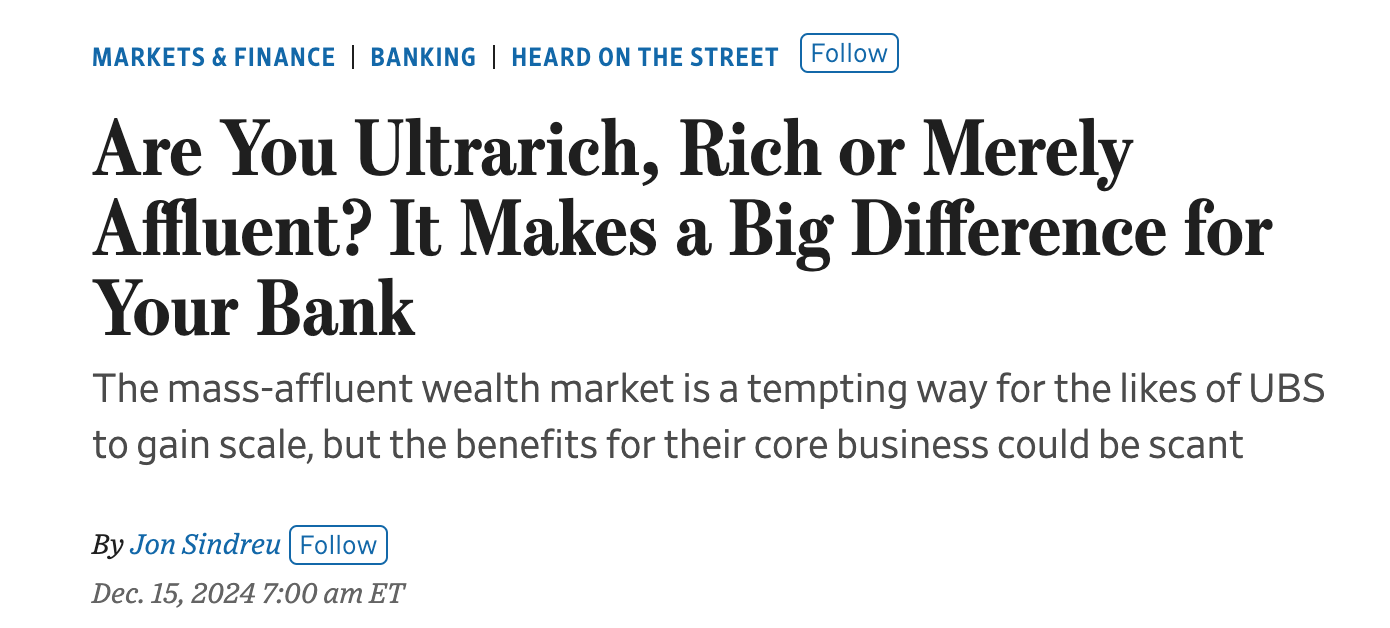
Below, I apply the translation manual to see if a viable research paper emerges.
Step 1. Initial Documentation
I came across this WSJ article recently, which examines how different wealth management strategies impact banks’ profitability, emphasizing the difference between catering to ultra-high-net-worth (UHNW) individuals versus the mass affluent.
- Timeline of Events
- Over the past decade, wealth management has become the most profitable segment in banking, generating stable fees with low capital requirements.
- Morgan Stanley built a wealth management empire through acquisitions (Smith Barney in 2009, Eaton Vance later), boosting its assets to $4.6 trillion and achieving a 29% pretax margin.
- UBS has $2 trillion in U.S. client assets but a lower 12% profit margin, prompting restructuring efforts post-Credit Suisse merger. In 2022, UBS attempted to acquire Wealthfront to expand into the mass-affluent market but abandoned the plan, concluding that it lacked a competitive advantage. Recently, UBS is exploring a broader U.S. banking license to enhance its ability to provide loans and deposits.
- Key Players and Their Actions
- Morgan Stanley, UBS, JPMorgan, Citi – Competing for ultra-high-net-worth and high-net-worth clients.
- Wealthfront – A digital-first investment platform that UBS sought to acquire but later abandoned.
- UBS Executives – Now focusing on family offices, IPO advisory, and selective expansion in the U.S. wealth market.
- Market Reactions
- Morgan Stanley’s success in wealth management has made it a model for other banks.
- The U.S. market remains difficult for foreign players like UBS due to the dominance of incumbent firms.
- Wealthfront, despite UBS backing out, has grown from $27 billion to $75 billion in assets in just two years.
- Policy & Regulation Changes
- Banks are exploring new regulatory frameworks that would allow them to expand lending and deposit-taking in the wealth space.
- Potential shifts in how different wealth tiers are serviced could affect market structure and competition.
- Similar Historical Episodes
- Morgan Stanley’s Post-2008 Pivot – Moved from traditional investment banking toward wealth management as a stable revenue source.
- Rise of Robo-Advisors – Firms like Wealthfront and Betterment disrupted traditional advisory services, pushing banks to rethink digital strategies.
Step 2. Pattern Matching
- Does this event fundamentally challenge how we think about markets? Yes Potentially. The profitability of wealth management versus traditional banking is well understood, but the systemic consequences of large-scale shifts in bank business models toward fee-based wealth management are less studied. If banks increasingly abandon traditional lending in favor of managing UHNW wealth, could this have unintended financial stability implications?
- Does this event let us finally measure something important that was previously unobservable? Possibly, but not obvious. The article does not highlight a new shock or dataset, but the long-run effects of banks pivoting from lending to advisory-based revenue models could be studied. If data on lending vs. fee-based activities were available, one could investigate how such shifts affect bank risk-taking, market liquidity, or credit availability.
- Does this present an empirical puzzle that needs a clean explanation? No Not in its current form. The profitability of UHNW clients vs. mass affluent is well known, and strategic differences between Morgan Stanley and UBS are not inherently puzzling. However, if one can tie this shift to a broader market outcome—such as the impact on capital allocation, credit supply, or financial fragility—then a meaningful puzzle might emerge.
Step 3. Feasibility Check
- Data Feasibility
- What data do we need?
- Bank-level data on business mix (lending vs. wealth management revenue), profitability, and risk exposure.
- Client segmentation data (UHNW vs. mass affluent) to measure how different client bases affect bank stability.
- Financial stability metrics (capital ratios, funding structures, credit intermediation) from regulatory filings.
- Regulatory changes or exogenous events that impact wealth management strategies.
- Does it exist? Partly Partially.
- Wealth management revenue and AUM data are available in bank regulatory filings (10-K, investor reports) and industry databases.
- Client segmentation data is limited—some banks report UHNW vs. mass affluent assets, but detailed breakdowns may not be public.
- Financial stability indicators exist, but linking them directly to bank business mix requires constructing a new dataset.
- Can we access it? Somewhat.
- Some data is publicly available (bank filings, SEC reports).
- More granular client data may require proprietary sources (Coalition Greenwich, Preqin, or Morningstar).
- What data do we need?
- Empirical Feasibility
- Identification Strategy
- Regulatory Shock: If there were a capital rule change (e.g., Basel treatment of wealth management assets), it could serve as an exogenous shock to test how banks adjust their business models.
- Difference-in-Differences: Compare banks that expanded wealth management exposure to those that did not, using an exogenous industry shock. - Instrumental Variable: Use variations in geographic exposure (e.g., state-level differences in UHNW client concentration) as an instrument for banks’ wealth management intensity. - Event Study: Examine financial stability metrics before and after major shifts in bank business mix (e.g., Morgan Stanley’s post-2008 pivot).
- Potential Challenges
- Endogeneity: Banks choose their wealth strategies endogenously, making causal inference difficult. - No obvious exogenous shock in the WSJ article—identification would need a policy change, market stress event, or external constraint to provide clean variation. - Data granularity: Wealth management is often bundled with other banking services, making it hard to isolate its direct effects on stability.
- Identification Strategy
- Regulatory Shock: If there were a capital rule change (e.g., Basel treatment of wealth management assets), it could serve as an exogenous shock to test how banks adjust their business models.
- External Validity
- Will this matter in five years? Yes Yes.
- Wealth management is becoming a dominant profit driver for banks, and its role in systemic stability remains an open question.
- The shift from lending to fee-based advisory could affect capital allocation in the economy.
- What broader question does this answer?
- Does the rise of wealth management-focused banks alter credit supply, systemic risk, and market stability?
- Are banks shifting away from lending due to regulation, profitability, or risk considerations?
- Do wealth-heavy banks behave differently in crises than lending-heavy banks?
- What are the policy implications?
- Should wealth management assets be treated differently in capital regulation?
- If banks rely more on wealth management, does this reduce their role in credit intermediation?
- Do UHNW-focused banks contribute to financial stability, or do they create new systemic risks?
Final Verdict: Is this a viable research question?
Yes Yes, if reframed as a study on how banks’ shift to wealth management affects systemic risk and credit supply. Perhaps someone should start writing on this topic.
Coda
Writing research papers, like any other skill, improves with practice. This manual provides a systematic way to evaluate research potential of a given news event early on. It won’t guarantee publication, but it can help steer you away from obvious dead ends. And sometimes, that’s all a good guide needs to do.