Will the Real Non-Bank Please Stand Up?
In this post, I look at how the term non-bank has been used in NBER working papers over time and why it has come to mean very different things in different contexts. By scraping papers that explicitly use the term, I trace how “non-bank” shifts from a narrow description of shadow banking to a broad residual category that often obscures more than it clarifies. I thank Olivier Darmouni for inspiration.
Introduction
The term non-bank appears frequently in modern finance and macro-finance research, but its meaning is not always the same across papers.
In some contexts, non-banks refer to asset managers such as hedge funds or money market funds. In others, the term includes broker-dealers, securitization vehicles, fintech lenders, or real estate investment trusts. In still other cases, non-bank is used as a broad category for financial intermediation that takes place outside the traditional banking sector.
Methodology
I collect all NBER working papers whose title or abstract contains the terms “non-bank,” “non-banks,” “nonbank,” or “nonbanks,” using a case-insensitive search. This yields a corpus of papers where the authors themselves explicitly chose to invoke the term, rather than papers that implicitly study non-bank institutions without naming them as such.
I then assign each paper to one or more categories based on the type of institution that the term “non-bank” is used to describe. I identify six main categories:
- Asset managers that directly hold risky claims — Hedge funds, mutual funds, pension funds, and other institutions that directly invest in securities and bear market risk on their balance sheets.
- Cash-like intermediaries and liquidity vehicles — Money market funds, repos, and other institutions providing deposit-like services or short-term funding markets.
- Fintech and platform-based lenders — Online lenders, peer-to-peer platforms, and other technology-enabled credit providers that emerged prominently in the 2010s.
- Securitization and structured vehicles — Special purpose vehicles, CDOs, and other entities created to pool and repackage financial claims.
- Real-asset intermediaries with financial leverage — REITs and other institutions that hold physical assets while using financial leverage.
- Residual category: NBFIs in macro and policy work — Papers that use “non-bank” as a catch-all for everything that isn’t a traditional deposit-taking bank, often in macro models or policy discussions.
The categorization isn’t always clean — some papers discuss multiple types of institutions. But as we will see, the exercise reveals something important: “non-bank” has never had a single, stable meaning in the economics literature.
Non-Bank Research Over Time
From 1984 to 2025, I find only 48 NBER working papers that explicitly invoke the term “non-bank” in their title or abstract. (See Appendix at the end of this post for the full list).
To put this in perspective, NBER publishes over 1,000 working papers per year. Despite all the recent policy attention to shadow banking and financial intermediation outside the banking sector, the actual use of “non-bank” terminology remains surprisingly rare in academic research.
The figure below summarizes the trends in non-bank research over time:
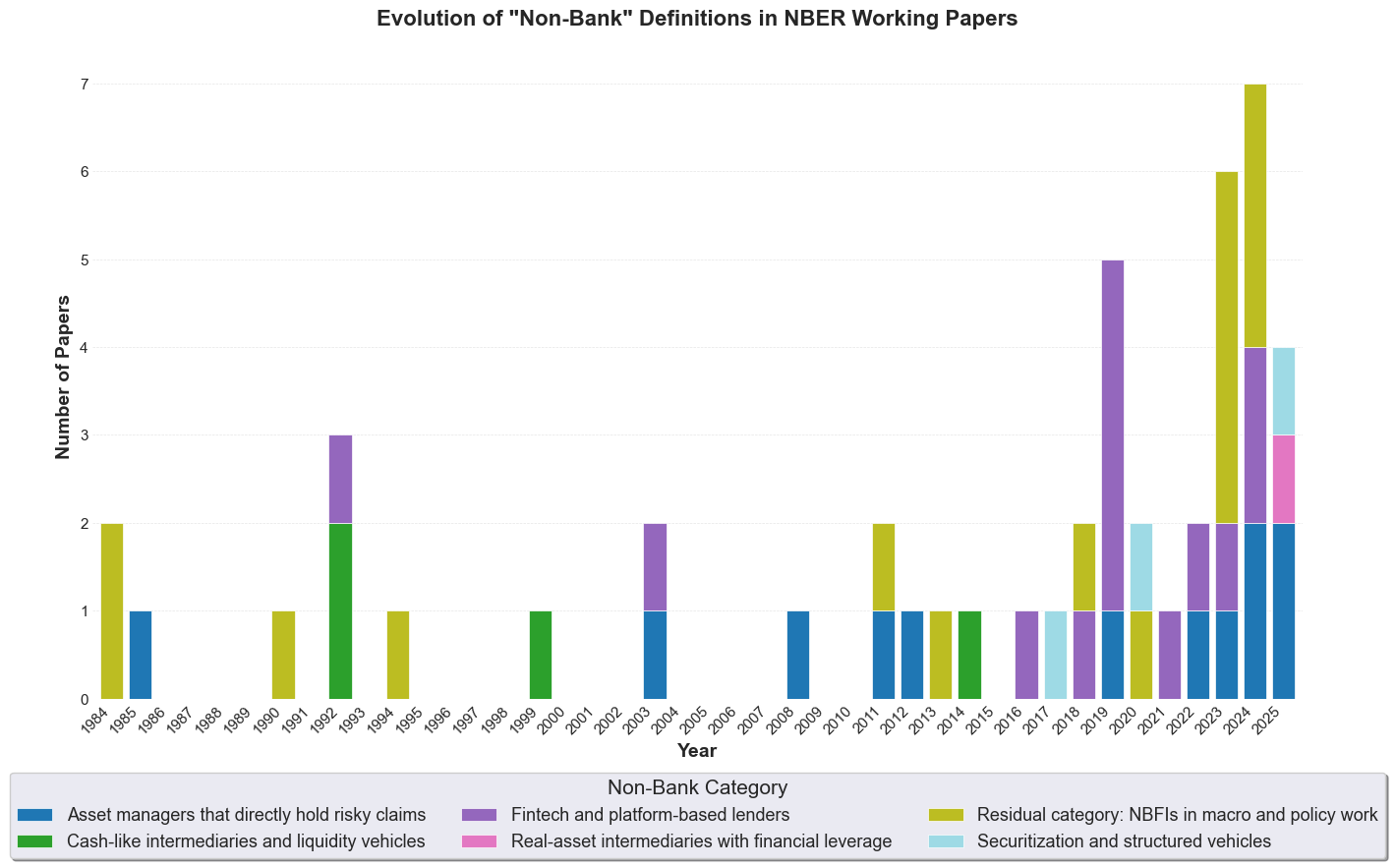
The pattern over time reveals three distinct phases:
- Early period (1984-1999): The term appears sporadically, primarily in two contexts. First, papers studying regulatory arbitrage, i.e. how financial institutions structured themselves to avoid banking regulation by operating as “non-bank banks.” Second, macro models that distinguished traditional banks from other financial intermediaries. In this era, “non-bank” was mostly a residual category defined by what it wasn’t (a regulated bank) rather than what it was.
- Middle period (2000-2014): Research slows to a trickle. The few papers that do use the term focus increasingly on asset managers and their role in financial markets. This likely reflects the growing importance of mutual funds and institutional investors in financial intermediation.
- Recent period (2015-2025): A dramatic surge, driven primarily by two forces. First, fintech lending emerges as a major research topic, with 11 papers in this category since 2015. Second, the term is increasingly used as a broad residual category in macro and policy work (9 papers), often to discuss “non-bank financial intermediaries” or “NBFIs” as a general class distinct from traditional banks.
What’s particularly striking is that 2024 alone accounts for 7 papers, more than any previous year. This recent spike coincides with heightened regulatory attention to non-bank financial intermediation following pandemic-era market stress and concerns about financial stability risks outside the traditional banking perimeter.
Implications
The shifting and imprecise usage of “non-bank” isn’t just semantic nitpicking. It has real implications for how we think about financial stability and regulation.
When policymakers discuss “non-bank vulnerabilities,” they’re implicitly grouping together institutions that may have little in common. A money market fund facing run risk looks very different from a hedge fund facing margin calls, which looks different from a fintech lender facing funding withdrawal. Lumping these together under “non-bank” risks designing one-size-fits-all policies for a heterogeneous sector.
Similarly, when macro models include a “non-bank sector,” what exactly is being modeled? If the category is defined purely as a residual, it may capture very different types of intermediation across different countries or time periods, making comparative analysis difficult.
Conclusion
The term “non-bank” has traveled a long journey from its origins describing regulatory arbitrage in the 1980s to its current status as an umbrella category covering everything from fintech platforms to asset managers. Along the way, it has become both more prominent and less precise.
The recent surge in “non-bank” research, particularly around fintech and macro policy questions, suggests growing recognition that financial intermediation increasingly happens outside traditional banking. But the terminological imprecision may hinder rather than help our understanding. Instead of lumping together everything that isn’t a bank, we might focus on the specific functions and risks of different intermediation models: platform lenders, asset managers, liquidity providers, and so on.
Until then, whenever you encounter “non-bank” in a paper or policy document, it’s worth asking: which non-bank? Because increasingly, the answer matters.
Appendix: List of Non-Bank NBER Working Papers
This appendix lists all 48 NBER working papers that explicitly use the term “non-bank” in their title or abstract (excluding false positives).
- Edward J. Kane (1984). “Technological and Regulatory Forces in the Developing Fusion of Financial-Services Competition.” NBER Working Paper No. 1320.
- Benjamin M. Friedman (1984). “Financial Intermediation in the United States.” NBER Working Paper No. 1451.
- Ben S. Bernanke, Mark L. Gertler (1985). “Banking in General Equilibrium.” NBER Working Paper No. 1647.
- Peter Garber, Steven Weisbrod (1990). “Banks in the Market for Liquidity.” NBER Working Paper No. 3381.
- Anil K. Kashyap, Jeremy C. Stein, David W. Wilcox (1992). “Monetary Policy and Credit Conditions: Evidence From the Composition of External Finance.” NBER Working Paper No. 4015.
- Anil K. Kashyap, Owen A. Lamont, Jeremy C. Stein (1992). “Credit Conditions and the Cyclical Behavior of Inventories: A Case Study of the 1981-82 Recession.” NBER Working Paper No. 4211.
- Gary Gorton, Richard Rosen (1992). “Corporate Control, Portfolio Choice, and the Decline of Banking.” NBER Working Paper No. 4247.
- Jonathan Eaton (1994). “Cross-Border Banking.” NBER Working Paper No. 4686.
- Benjamin M. Friedman (1999). “The Future of Monetary Policy: The Central Bank as an Army With Only a Signal Corps.” NBER Working Paper No. 7420.
- Patrick McGuire (2003). “Bank Ties and Bond Market Access: Evidence on Investment-Cash Flow Sensitivity in Japan.” NBER Working Paper No. 9644.
- Elizabeth W. Croft, Barbara J. Spencer (2003). “Fees and Surcharging in automatic teller machine networks: Non-bank ATM providers versus large banks.” NBER Working Paper No. 9883.
- Joshua D. Rauh, Amir Sufi (2008). “Capital Structure and Debt Structure.” NBER Working Paper No. 14488.
- Bo Becker, Victoria Ivashina (2011). “Cyclicality of Credit Supply: Firm Level Evidence.” NBER Working Paper No. 17392.
- Barry Eichengreen, Nergiz Dincer (2011). “Who Should Supervise? The Structure of Bank Supervision and the Performance of the Financial System.” NBER Working Paper No. 17401.
- Jongha Lim, Bernadette A. Minton, Michael Weisbach (2012). “Syndicated Loan Spreads and the Composition of the Syndicate.” NBER Working Paper No. 18356.
- Viral V. Acharya, Sascha Steffen (2013). “The “Greatest” Carry Trade Ever? Understanding Eurozone Bank Risks.” NBER Working Paper No. 19039.
- Stefan Nagel (2014). “The Liquidity Premium of Near-Money Assets.” NBER Working Paper No. 20265.
- Efraim Benmelech, Ralf R. Meisenzahl, Rodney Ramcharan (2016). “The Real Effects of Liquidity During the Financial Crisis: Evidence from Automobiles.” NBER Working Paper No. 22148.
- Zhuo Chen, Zhiguo He, Chun Liu (2017). “The Financing of Local Government in China: Stimulus Loan Wanes and Shadow Banking Waxes.” NBER Working Paper No. 23598.
- Claudia M. Buch, Matthieu Bussiere, Linda Goldberg, Robert Hills (2018). “The International Transmission of Monetary Policy.” NBER Working Paper No. 24454.
- Richard T. Thakor, Robert C. Merton (2018). “Trust in Lending.” NBER Working Paper No. 24778.
- Itamar Drechsler, Alexi Savov, Philipp Schnabl (2019). “How Monetary Policy Shaped the Housing Boom.” NBER Working Paper No. 25649.
- Jason Roderick Donaldson, Giorgia Piacentino, Anjan Thakor (2019). “Intermediation Variety.” NBER Working Paper No. 25946.
- Stefan Gissler, Rodney Ramcharan, Edison Yu (2019). “The Effects of Competition in Consumer Credit Market.” NBER Working Paper No. 26183.
- René M. Stulz (2019). “FinTech, BigTech, and the Future of Banks.” NBER Working Paper No. 26312.
- Sergey Chernenko, Isil Erel, Robert Prilmeier (2019). “Why Do Firms Borrow Directly from Nonbanks?.” NBER Working Paper No. 26458.
- Victoria Ivashina, Boris Vallee (2020). “Weak Credit Covenants.” NBER Working Paper No. 27316.
- Kristin J. Forbes (2020). “The International Aspects of Macroprudential Policy.” NBER Working Paper No. 27698.
- Andreas Fuster, Aurel Hizmo, Lauren Lambie-Hanson, James Vickery, Paul S. Willen (2021). “How Resilient Is Mortgage Credit Supply? Evidence from the COVID-19 Pandemic.” NBER Working Paper No. 28843.
- Sergey Chernenko, David S. Scharfstein (2022). “Racial Disparities in the Paycheck Protection Program.” NBER Working Paper No. 29748.
- Xiang Fang, Bryan Hardy, Karen K. Lewis (2022). “Who Holds Sovereign Debt and Why It Matters.” NBER Working Paper No. 30087.
- Anusha Chari (2023). “Global Risk, Non-Bank Financial Intermediation, and Emerging Market Vulnerabilities.” NBER Working Paper No. 31143.
- Kristin Forbes, Christian Friedrich, Dennis Reinhardt (2023). “Stress Relief?: Funding Structures and Resilience to the Covid Shock.” NBER Working Paper No. 31255.
- Linda S. Goldberg (2023). “Global Liquidity: Drivers, Volatility and Toolkits.” NBER Working Paper No. 31355.
- Joshua Bosshardt, Ali Kakhbod, Amir Kermani (2023). “The Value of Intermediaries for GSE Loans.” NBER Working Paper No. 31575.
- Viral V. Acharya, Maximilian Jager, Sascha Steffen (2023). “Contingent Credit Under Stress.” NBER Working Paper No. 31909.
- Nathan Foley-Fisher, Gary B. Gorton, Stéphane Verani (2023). “The Informational Centrality of Banks.” NBER Working Paper No. 32007.
- Isil Erel, Eduard Inozemtsev (2024). “Evolution of Debt Financing toward Less-Regulated Financial Intermediaries in the United States.” NBER Working Paper No. 32114.
- Victoria Ivashina, Şebnem Kalemli-Özcan, Luc Laeven, Karsten Müller (2024). “Corporate Debt, Boom-Bust Cycles, and Financial Crises.” NBER Working Paper No. 32225.
- Viral V. Acharya, Nicola Cetorelli, Bruce Tuckman (2024). “Where Do Banks End and NBFIs Begin?.” NBER Working Paper No. 32316.
- Wenxin Du, Kristin Forbes, Matthew N. Luzzetti (2024). “Quantitative Tightening Around the Globe: What Have We Learned?.” NBER Working Paper No. 32321.
- Zhiguo He, Jing Huang, Cecilia Parlatore (2024). “Information Span in Credit Market Competition.” NBER Working Paper No. 33141.
- Viral V. Acharya, Markus K. Brunnermeier, Diane Pierret (2024). “Systemic Risk Measures: From the Panic of 1907 to the Banking Stress of 2023.” NBER Working Paper No. 33211.
- Laura Alfaro, Saleem A. Bahaj, Robert Czech, Jonathon Hazell, Ioana Neamtu (2024). “LASH risk and Interest Rates.” NBER Working Paper No. 33241.
- Abhishek Bhardwaj, Shan Ge, Saptarshi Mukherjee (2025). “Does Loan Securitization Expose Borrowers to Non-Bank Investor Shocks?—Evidence from Insurers.” NBER Working Paper No. 33449.
- Viral V. Acharya, Manasa Gopal, Maximilian Jager, Sascha Steffen (2025). “Shadow Always Touches the Feet: Implications of Bank Credit Lines to Non-Bank Financial Intermediaries.” NBER Working Paper No. 33590.
- Stefan Avdjiev, Leonardo Gambacorta, Linda S. Goldberg, Stefano Schiaffi (2025). “The Risk Sensitivity of Global Liquidity Flows: Heterogeneity, Evolution and Drivers.” NBER Working Paper No. 33674.
- Viral V. Acharya, Manasa Gopal, Sascha Steffen (2025). “Fragile Financing? How Corporate Reliance on Shadow Banking Affects their Access to Bank Liquidity.” NBER Working Paper No. 33760.