The Curse of the OECD Average
In this post, I explore why governments may choose policies that align with OECD averages. I have a simple model to examine how uncertainty and risk aversion influence policy decisions that balance domestic needs with international standards.
Introduction
One of my biggest pet peeves about the Korean media is its frequent obsession with aligning various domestic metrics—like wages, the number of doctors, or education spending—with international norms, especially those of the OECD countries. Here’s on example from The Korea Herald:
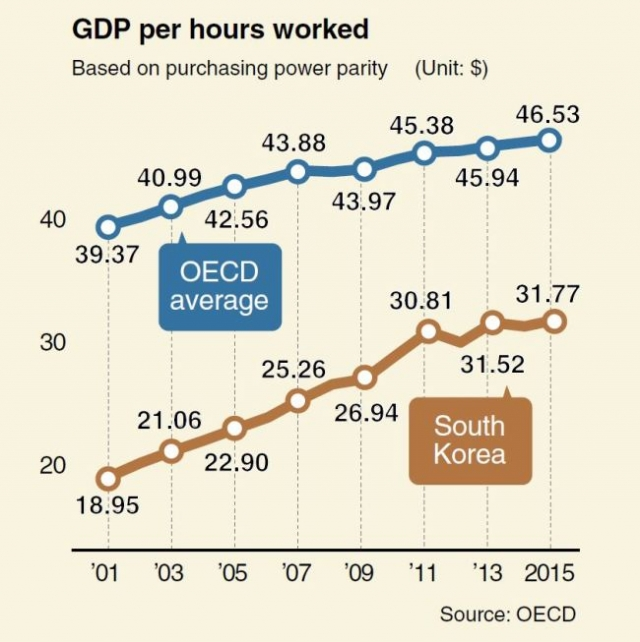
This fascination with “keeping up with the global Joneses” raises an interesting question: Why do governments feel compelled to match international averages, and how does this influence their policy decisions? In this post, I’ll write down a simple economic model that sheds light on why governments might deliberately steer their policies toward global averages. We’ll think about which factors make certain policies more susceptible to this convergence and discuss how uncertainty and risk aversion play a role.
A Simple Model of Policy Convergence
Let’s imagine a government that wants to make its citizens as well-off as possible but also feels the pressure to align its policies with international standards—specifically, the averages of OECD countries. These policies could be anything from tax rates to healthcare spending.
We’ll represent the government’s policy choices as a set of variables:
- Policy variables: \(\mathbf{p}=(p_1,p_2,…,p_n)\) as representing different policy choices (e.g., tax rates, education spending, healthcare investment)
- OECD averages: \(\mathbf{\bar{p}} = (\bar{p}_1, \bar{p}_2,…,\bar{p}_n)\) as the average values of each policy among OECD countries.
Government’s Utility Function
I’m now going to assume that the government’s overall satisfaction (utility) depends on two things:
- How the chosen policies directly benefit the country (e.g. economic performance)
- The political or economic costs of deviating from international norms.
We can thus express the government’s utility as:
\[U(\mathbf{p})=W(\mathbf{p})-\sum_{i=1}^n \lambda_i(p_i-\bar{p}_i)^2\]\(W\) is the domestic welfare function, which is concave and \(\lambda_i\) is the policy-specific sensitivity to deviating from the OECD average for policy \(p_i\).
Micro-founding \(\lambda_i\)
Why might we have different \(\lambda_i\) for each policy \(i\)? Well not all policies are created equal when it comes to international comparison. For example, education spending is easily comparable across countries since it’s usually measured as a percentage of GDP. Tax rates are also straightforward to compare. But policies like environmental regulations or labor market protections are harder to align since they depend heavily on local conditions and institutional frameworks. Similarly, the pressure to conform varies - deviating from international norms on issues like human rights or financial regulations might trigger serious diplomatic consequences, while having slightly different zoning laws probably won’t raise many eyebrows.
To capture these aspects, we can define two variables: (i) the ease of comparison, which I’ll denote as \(E_i\), and (ii) the cost of standing out from the “pack”, which I’ll denote as \(C_i\).
- First, \(E_i\) reflects the fact that the ease with which a policy can be compared internationally influences the government’s sensitivity to the OECD average. This will depend on factors like the degree to which a policy has internationally recognized metrics, the accessibility and transparency of data related to \(p_i\), and the extent to which differences in policy contexts can be normalized.
- Second, \(C_i\) reflects the negative consequences of deviating from international norms affect the government’s inclination to align with OECD averages. So effectively \(C_i\) represents the political and economic costs of not conforming to the OECD average in policy \(p_i\). This can include things like international pressure, public opinion favoring alignment with international standards, and potential effects on foreign relations.
We can thus model \(\lambda_i\) as a function of \(E_i\) and \(C_i\):
\[\lambda_i = f(E_i ,C_i) = \alpha E_i C_i\]where for simplicity, I assumed a multiplicative relationship. \(\alpha\) is a scaling parameter reflecting the overall weight given to international alignment in the government’s utility function.
Optimal Policy Choice
The government chooses \(\mathbf{p}\) to maximize \(U(\mathbf{p})\):
\[\max_{\mathbf{p}}\qquad U(\mathbf{p})=W(\mathbf{p})-\sum_{i=1}^n \lambda_i(p_i-\bar{p}_i)^2\]Taking the first-order condition for each policy yields:
\[p_i = \bar{p}_i + \frac{1}{2\alpha E_i C_i}\frac{\partial W}{\partial p_i}\]So the optimal policy is a weighted average between the OECD average (\(\bar{p}_i)\) and the domestic welfare-maximizing policy. The second term effectively captures the adjustment away from the OECD average based on the marginal benefit of the policy to domestic welfare, i.e. how much the government is willing to deviate from the OECD average in pursuit of domestic gains.
Note that the second term becomes important in two main scenarios:
- Low \(\lambda_i\), which means the government places less importance on aligning with the OECD average. This could be due to low ease of comparison \((E_i)\) or low cost of standing out \((C_i)\). For example, a government’s policy on doctor pay - while OECD averages exist, compensation structures vary widely based on healthcare systems, making direct comparisons difficult. With low comparison pressure, countries like Korea can maintain different physician salaries without significant international scrutiny.
- Marginal benefit \(\partial W / \partial p_i\) is large, which would be true in cases where a policy area is crucial for domestic well-being, prompting the government to deviate more from \(\bar{p}_i\) to capitalize on these welfare gains. For example, corporate tax rates in export-dependent economies - even if OECD averages suggest higher rates, a country might maintain significantly lower corporate taxes to attract manufacturing firms, as the economic benefits (jobs, exports, technology transfer) outweigh the costs of deviating from international norms.
Limitations
While this simple model offers some insights into why governments might align their policies with international averages, it rests on the assumption that policymakers have complete certainty about how each policy will impact domestic welfare.
But in reality, governments often face significant uncertainty regarding the outcomes of their policy choices. For example, economic conditions are unpredictable, and the effects of policies might not be immediately apparent or could vary over time. This uncertainty means that risk-averse governments might prefer to “play it safe” by aligning more closely with international norms, using them as a benchmark to mitigate potential risks.
Extension with Uncertainty
Now let’s consider an extension with uncertainty and see how it influences the government’s optimal policy decisions.
Incorporating Uncertainty and Risk Aversion
We now introduce uncertainty into the government’s decision-making process and assume that the government is risk-averse. The government’s utility now depends not only on the expected welfare but also on the variance of welfare outcomes.
We consider a single policy \(p\) for simplicity and define the government’s utility function as:
\[U(p) = \mathbb{E}[W(p)]-\frac{A}{2}Var[W(p)]-\lambda(p-\bar{p})^2\]And for nice math, let’s assume that the welfare function is quadratic and subject to uncertainty:
\[W(p) =kp-\frac{g}{2}p^2+(p-\bar{p})\tilde{\epsilon}, \qquad\tilde\epsilon\sim\mathcal{N(0,\sigma^2)}\]The welfare function thus has both a deterministic component and a stochastic component. The deterministic component reflects diminishing marginal returns, and the stochastic component accounts for unpredictable factors that can affect the actual impact of the policy.
- Notice that we model the uncertainty in a very particular way — the risk increases as policy deviates from the OECD average. This captures the intuitive idea that governments face more unpredictable outcomes when they venture far from established international norms.
Optimal Policy Choice
Now the government chooses \(p\) to maximize \(U(p)\). Note that we have:
\[\mathbb{E}[W(p)]= kp-\frac{g}{2}p^2\] \[Var[W(p)]=(p-\bar{p})^2\sigma^2\]Thus, the government’s problem is now:
\[\max_p \quad U(p)=kp-\frac{g}{2}p^2 -\frac{A}{2}(p-\bar{p})^2\sigma^2 - \lambda(p-\bar{p})^2\]And solving for \(p\) yields:
\[p^*=\frac{k+(A\sigma^2 + 2\lambda)\bar{p}}{g+2\lambda+A\sigma^2}\]Now we can rewrite \(p^*\) as:
\[p^* = w \cdot \bar{p} + (1-w)\cdot \frac{k}{g}\]where the weight \(w\) is given as:
\[w=\frac{A\sigma^2 + 2\lambda}{g+A\sigma^2+2\lambda}\]This shows that the government’s optimal policy \(p^*\) is essentially a weighted average of two components: (1) the OECD average policy \(\bar{p}\) and (2) the domestic welfare-maximizing policy without uncertainty, \(k/g\). The weight \(w\) determines how much emphasis the government places on aligning with international norms versus focusing on domestic welfare.
- Specifically, \(w\) increases with both the level of uncertainty \((\sigma^2)\), the risk aversion of the government \((A)\), the cost of deviating from international norms \((\lambda)\).
- This means that as uncertainty or the penalties for not conforming grow, the government is more inclined to adopt policies closer to the OECD average.
Alternate Definitions of Uncertainty
One can think about a different way to model the uncertainty by attaching the uncertainty directly to the policy choice itself, i.e. using \(p\tilde{\epsilon}\) instead of \((p-\bar{p})\tilde\epsilon\). This formulation suggests that the uncertainty in welfare outcomes is proportional to the magnitude of the policy, regardless of how it compares to international norms.
This leads to a result where the government may choose a smaller \(p\) to mitigate the increased risk associated with larger policy interventions. Intuitively, as the uncertainty grows with the size of the policy, a risk-averse government will prefer to limit its policy scope to reduce potential negative impacts, prioritizing caution over ambitious policy changes.
So this would introduce a separate force that can either contribute to convergence or divergence, depending on the specific context. Unlike the previous model where uncertainty was associated with deviations from the international norm (which always incentivized convergence), here the effect will be more nuanced.
Empirical Tests
Now let’s think about empirical tests that examine whether governments adjust their policies toward international norms. The first natural step is to come up with a measure that captures the distance to the OECD average for each country:
\[Distance_{ict}=|Policy_{ict}-\bar{Policy}_{it}|\]Once we have some measure of distance for each policy \(i\) for each country \(c\) in each year \(t\), we can then think about some empirical tests.
- One way to test for policy convergence is to exploit the staggered timing of countries joining the OECD. If OECD membership influences a country’s policies to align more closely with OECD averages, we should observe a shift in policy variables after membership.
- We can also test to see if policies with higher ease of comparison and cost of standing out exhibit greater convergence toward OECD averages after membership. This would require measuring the ease of comparison \(E_i\) and the cost of standing out \(C_i\).
- Another heterogeneity test we can exploit is the uncertainty about policy outcomes. Our model predicts that policies with greater uncertainty will show stronger convergence to the international average due to the government’s risk-averse behavior.
- Risk aversion may vary across different government structures or political ideologies. For example, coalition governments may be more risk-averse due to the need for consensus. Or left-leaning governments might prioritize social welfare, affecting their risk tolerance.
Conclusion
It’s probably not too crazy to assume that governments weigh domestic welfare against international conformity when making policy choices. In this world, risk and uncertainty typically push policies toward OECD averages, while strong domestic benefits can justify deviation. Potentially, this framework can explain a country’s focus on OECD benchmarks.
Future research could test these predictions empirically by examining how policies change when countries join the OECD. I personally believe this international convergence force significantly shapes government decision-making, as we see in cases like Korea’s persistent drive to match OECD averages in healthcare spending and teacher salaries.