Conference Recap: A Week of AI in the Bay Area
This entry pertains to two events held a week apart: the Google Higher Education Faculty AI Fellowship Institute (Sunnyvale, September 17-18, 2026) and the AGI Economy Conference hosted by OpenAI (San Francisco, September 24, 2026).
Introduction
This year I was selected as one of the Google Higher Education Faculty AI Fellows, and the event in Sunnyvale was the first time the fellows met in person. A week later I was invited to the AGI Economy Conference at OpenAI, organized by Ronnie Chatterji and the OpenAI economic research team. I am building a new AI in Finance elective for the spring, so the timing worked out well.
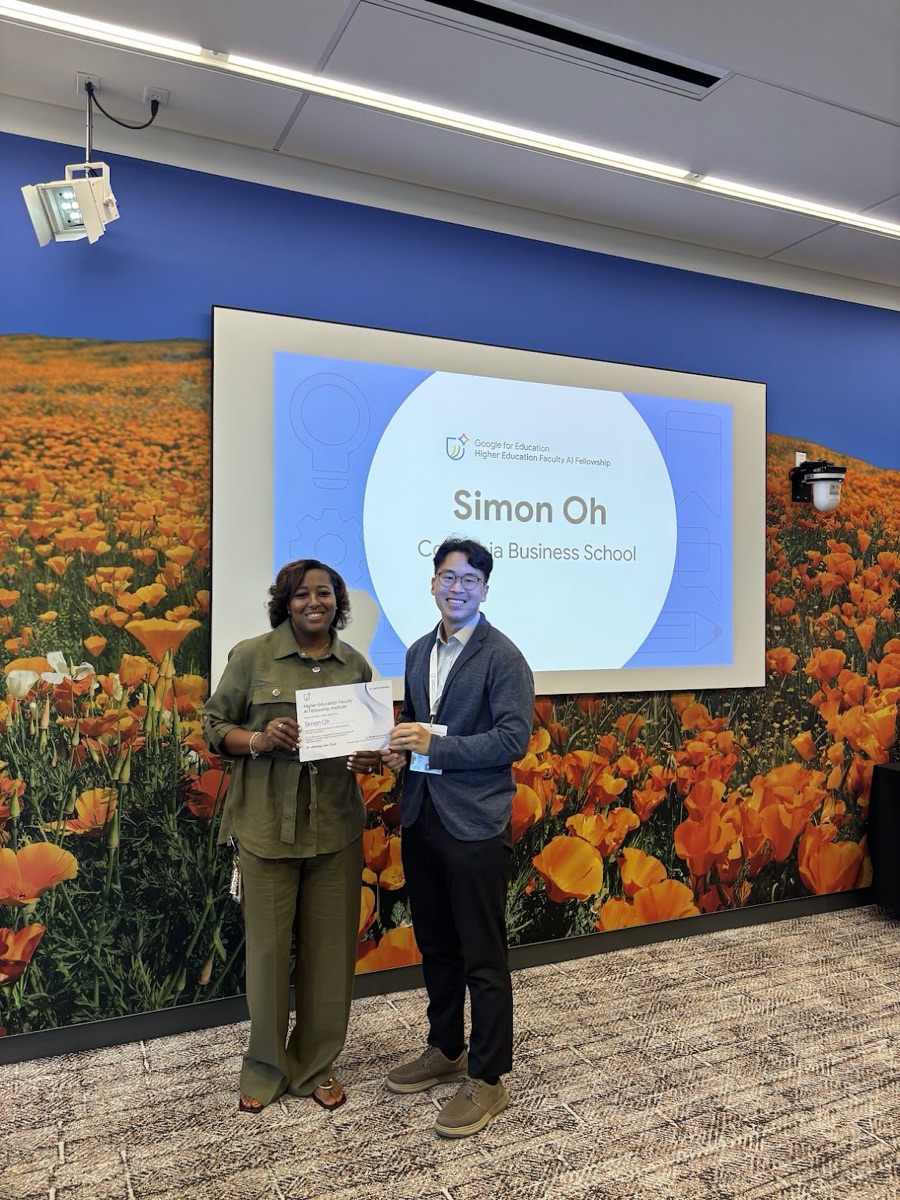
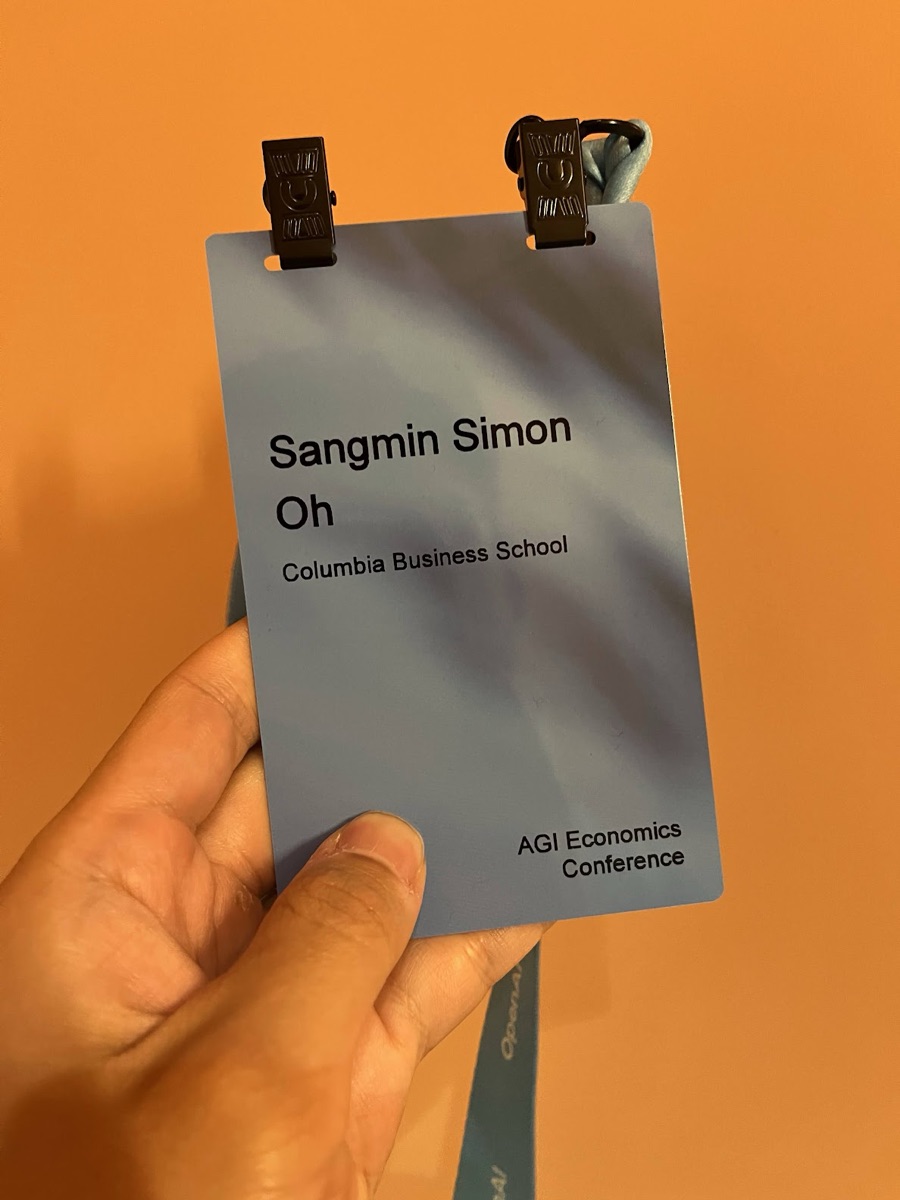
The Google institute was primarily about teaching with AI: what the classroom should look like and how to assess students. The OpenAI conference was more research-focused, which ended up primarily about measuring AI: how firms, researchers, and workers use it, and how much of that use shows up in output.
Part I: Google Higher Education Faculty AI Fellowship Institute
This was a two-day event that mixed keynotes, design sprints, and short “fellowship stories” in which fellows presented what they had built at their home institutions. Some of the sessions covered product features under NDA, so I leave those out.
Day 1
Keynote: Learning Science at Google
- Julia Wilkowski (Head of Learning Science, Google) gave the opening keynote on five learning-science principles that guide Google’s education tools: (1) inspire active learning, (2) manage cognitive load, (3) deepen metacognition, (4) motivate curiosity, and (5) adapt to the learner. One finding from their user research was that students strongly dislike questions that are not multiple choice. It was great to see that Google cared a lot about these metrics when designing their AI systems. At the same time, I was not sure how many of the principles apply directly to “vocational” training such as an MBA, where the goal is closer to professional judgment than to mastery of a fixed body of knowledge.
Mindset and Socratic Thinking
- This session was a short exercise called the “double-loop swap.” Each of us wrote down an institutional problem and our immediate quick fix, for example “students use AI on essays, so add an oral presentation or run a detector.” A partner then asked two questions: what are we actually trying to teach or test here, and what would a student say is broken about it? The last step was to rewrite the problem as “the real problem isn’t the surface issue; it’s that our current approach fails to achieve a core learning goal for a specific group of students.” The exercise was simple, but it was effective at moving the conversation away from detection and toward the learning goal.
Breakout: Pedagogy
- The pedagogy breakout started from the question of whether grading the final artifact was ever a true measure of learning, or whether AI simply broke the illusion. One business school faculty argued that critical thinking is overrated, and a computer scientist in the room pushed back. An architecture professor said that much of his teaching has turned into taste training (is this a bad thing?). The phrase I wrote down was that learning should be “spiky” rather than “fluffy.” Across the two days, the most common view was that delivering content is no longer the bottleneck, and that we need to learn to evaluate the process of thinking rather than the output.
Fellowship Stories I
- Kehinde Badiru (English and writing) teaches writing with Gemini as a partner, including an essay assignment in which students choose a conspiracy theory and try to convince the class that it is true.
- Rania Labib (Prairie View A&M) teaches energy modeling, which is very tool-intensive, and built GlassBox to make those tools accessible. The workflow is that the AI proposes, the student decides, and the tool produces a presentation that records the decisions.
- Christie Shin (FIT, SUNY) presented a “cognitive process assessment” that grades how students work with AI rather than the final product. Students are asked to find three kinds of errors in AI output: attribution errors (facts the AI made up), logical errors (steps that do not follow), and representational errors.
- Paige LaBarr (Finger Lakes Community College) asks students to rank each task in the course on a spectrum from “cheating” to “totally fine,” which makes the AI policy something the class builds together.
Design Sprint
- The design sprint asked what the lecture hall should look like in 2030. The facilitators borrowed the Google product process: start from a specific user and write “how might we” statements rather than “how should we.” The example was Waymo, which initially focused on people who could not drive. My group worked on how students from diverse backgrounds could have an equally rewarding learning experience, and my three ideas were an AI interpreter with a simple physical interface, a more personalized experience for each student, and structured discussion before class to help students overcome cultural barriers to speaking up. Other groups proposed more micro-activities, more theater-like classrooms, and classrooms that can be rebuilt like Lego blocks.
Fellowship Stories II
- Karen Jacobs (Boston University) described a student-faculty AI affinity group. Her observation was that both sides are working through the same uncertainty, but faculty worry about integrity while students worry about rules that keep shifting.
- Amy Kinser and Will Geoghegan (Indiana Kelley) described how Kelley moved faster than committee speed: about 200 faculty spent summer hours redesigning courses, the school released a faculty AI playbook, and there are now nine AI-focused MBA courses.
Talk: AI for Learning at Google DeepMind
- Garrett Honke (Google DeepMind) made the point that training an AI system to tutor well is harder than training it to solve the hardest math problems. The reason is that math has a verification loop and tutoring does not. An interesting point he made is that most AI tools have converged on being “helpful and harmless,” which may not be what we want from an educator.
Day 2
The second day started with a tour of the Mountain View campus, which was a cool experience.
Fellowship Stories III
- Melissa Geil (UNC Kenan-Flagler) presented on neurodivergent candidates and AI-mediated recruiting.
- Negar Farakish (NYU School of Professional Studies) described an AI “pedagogical coach” for faculty. The design starts from a specific teaching challenge, builds a knowledge base, defines how the agent should coach, and adds human-centered guardrails.
- Natalya Pasklinsky (Columbia Nursing) described ambient charting in nursing, where the AI listens and drafts the note and the nurse reviews it. She described the cognitive shift as moving from remembering to verifying, which raises the question of what nurses now need to be taught.
- Julianna Gesun (Embry-Riddle) pointed out that online asynchronous courses hide the signals instructors use to adapt, such as confused faces. She is exploring whether emotional and behavioral cues can be used to measure engagement.
Part II: AGI Economy Conference at OpenAI
The conference ran from morning to evening with nine sessions. OpenAI had a beautiful office.
Opening: AI Geopolitics
- Jake Sullivan (former U.S. National Security Advisor) opened with a discussion of compute export controls, which he called a “no-brainer” since compute is China’s binding constraint. He said it is too early to judge whether they were a large success or a modest advantage in a critical window. He also flagged global diffusion as the underexplored “fourth race”: whoever builds the AI backbone for other countries is likely to keep them on it.
Session 1: How AI Can Accelerate Scientific Discovery
- Annie Liang (Northwestern) presented “AI and the Production of Research” (with Tyler Wu). AI raises the average quality of each researcher’s ideas, but it also correlates them, since two researchers asking the same model the same question get similar answers. If the scientific frontier is the best idea produced, this correlation lowers the chance of an exceptional draw. With thin-tailed idea distributions AI makes the frontier worse and can leave everyone worse off. With heavy enough tails the larger number of ideas wins. I liked her description of what a theory paper is for, namely to tell us which parameters to measure. Here the two parameters are how much AI correlates ideas and how thick the tail of the idea distribution is.
- Ryan Hill (Northwestern) presented “How Artificial Intelligence Shapes Science: Evidence from AlphaFold” (with Carolyn Stein). AlphaFold did not displace experimental structural biologists, since high-stakes structures still need experimental confirmation and the predictions make experiments more efficient. Basic research shifted toward proteins whose structures were newly solved, but patents did not. Structure is necessary but not sufficient for applied work, and other bottlenecks in the drug pipeline still bind.
- Chris Liao (UC Berkeley) presented “How Scientists Use AI,” based on about 2,000 academics on the ChatGPT Research plan and a privacy-preserving classifier. Four activities (reading, software development, writing, and analysis) account for over 80% of messages, while data gathering and peer review barely register.
Session 2: Fireside Chat with Tyler Cowen
- Tyler Cowen (George Mason) started from a Gallup poll in which 93% of respondents in China say AI is more likely to be good for them, compared with 36% in the U.S. His career advice for economists was that investing in paper quantity is a worse strategy than ever, and that the human contribution will be finding and vetting new data, knowing institutions, connecting literatures, and having networks. He has proposed that universities let students take one class over four years that is run entirely by AI, and no university has accepted. On loss of control, he said: “We never had control. What we have is the illusion of control.”
Session 3: How Companies Are Translating AI into Productivity
- Rembrand Koning (HBS) presented “AI-Native Firms” (with Hyunjin Kim). Among 47,000 startups founded from 2020 to 2025, AI-native firms are about 25% smaller, more senior, more technical, and flatter. Since the sample predates coding agents, the mechanism is AI in the product rather than AI as a worker tool. In a separate RCT with 515 startups (“Mapping AI into Production”), teaching founders how AI startups reorganize their workflows led treated firms to raise 40% less capital and reach $100K in revenue more often (32% vs. 19%).
- Andrea Contigiani (Ohio State) presented “Entrepreneurship, Experimentation, and Generative AI,” which compares startups that had machine-learning talent before ChatGPT to those that did not. The AI-ready firms cut the staff who run experiments by about 8%, with no change in experimentation tools and no change in performance so far. He also cautioned that Revelio job titles are edited retroactively, so pre-trends in job-title data need care.
- Fiona Chen (Harvard) presented “Artificial Intelligence in the Firm: Bottlenecks in Software Production,” using data on about 700 firms and 700,000 developers. After firms adopt AI coding tools, lines of code rise about 70%, but deployed code rises only about 8%. Code review is the bottleneck: review queues grow, and reviewers block more pull requests and request more revisions. This was one of the clearest demonstrations I have seen that task-level productivity gains need not pass through to output.
Session 4: How AI Will Transform Jobs
- Whitney Zhang presented “Adversarial Hiring.” Applications per job have more than doubled since 2022, and AI-written applications no longer carry the “soft signals” that a careful cover letter once did. Firms respond with longer interviews, more referrals, and more experienced hires. Occupations that rely more on soft signals see larger drops in entry-level hiring, accounting for about 22% of the overall decline.
- Angelica Bozzi (UCL) presented “AI Intermediation and Access to Jobs: Evidence from a Job-Matching Platform” (with Sida Peng and Francesca Bianchi). An Italian hospitality platform replaced human screeners with an LLM. On identical applications, the AI and human shortlists overlap only about 30%, and migrant hiring rises about 50% when the AI screens. The human penalty against migrants varies widely across screeners, while the AI’s penalty is smaller and uniform, which makes it easier to audit and correct.
- Rishi Bommasani (Stanford) presented “Enhancing Exposure” (paper), where he tackles a basic missing input for task-based models: how much time workers spend on each task. O*NET reports how often a task is done but not how long it takes, so he asks LLMs which of two tasks takes longer, combines the answers with O*NET frequencies, and solves for time shares in every occupation. I thought this was very clever, and the dataset should be useful to many of us. As it turns out, the resulting exposure estimates are more conservative than earlier ones.
Session 5: Measuring AI’s Economic Impact
- Jacob Carlson presented “Using Benchmark Datasets to Correct for Measurement Error in Privacy-Preserving Classifiers of AI Usage.” Labs label usage data with LLM classifiers because no human may read the transcripts, and the usual validation is a correlation on an external benchmark. His point is that the benchmark can do more: measure the classifier’s error where the truth is visible, reweight that error to look like the usage data, and subtract it. The classifier does not need to be accurate, only wrong in a way that can be measured and transported. The same logic applies to any variable we build with an LLM.
- Bharat Chandar (Stanford Digital Economy Lab) presented the AI Economic Indicators, a set of monthly dashboards. The headline numbers are no widespread displacement yet, a continued slowdown for young workers in exposed occupations, AI adoption at work approaching 50%, and about $183B in consumer surplus from generative AI.
- Yechan Park (Harvard) presented “The Distributional Effects of AI’s Productivity Gains,” which aims to estimate the productivity gain from AI for each of about 800 occupations. Experiments are unbiased but cover only about 10 occupations, while usage-based indices cover everything but have no counterfactual. For consultants, the HBS field experiment finds a gain of about 1.3x, while the Anthropic index implies about 10x. He combines the two, borrowing strength across occupations, and the calibrated gains fall to about 1-2x with much less variation across occupations. Together with Carlson’s paper, it shows how a small trusted sample can correct a large LLM-labeled one.
Session 6: How Agents Navigate the Economy
- Isaiah Andrews (MIT) presented “Incoherent Agents Are Exploitable: Testing the Economic Rationality of AIs” (see “Dutch Books for Language Models” with Suproteem Sarkar). The idea goes back to de Finetti: an agent’s forecasts are coherent if and only if no adversary can extract a guaranteed profit from them. If a model says there is a 60% chance of any rise in a stock and a 70% chance of a large rise, you can pocket 10 cents without knowing anything about the stock. The test does not require knowing the outcome. Across 15 models, coherence varies by a factor of about 100, and the most coherent model was an open-weight model from 2025 rather than the most capable recent one. This seems like a natural tool for any exercise that uses an LLM as a forecaster or investor.
- Benjamin Manning (MIT) presented “General Social Agents” (with John Horton). For every paper showing that LLM simulations predict human responses well, another shows that they fail. His recipe is to write down the theory first, build agents that embody it, calibrate them on existing human datasets, and validate on held-out ones before trusting them in a new setting. This is the same discipline one would apply to a structural model. In the Q&A he made the point that more capable models may become worse proxies for humans, since they converge on a single point of view.
Session 7: Fireside Chat with Dylan Patel
- Dylan Patel (SemiAnalysis) discussed the financing of AI infrastructure. Hyperscalers will issue hundreds of billions in debt next year, much of it off balance sheet, and they are insensitive to rates at their project returns. He noted a puzzle for IO economists: prices barely move where supply is monopolized (ASML, TSMC) but have multiplied where there are many competitors (DRAM, data-center and power developers). I asked about two concerns from the finance side: residual value guarantees and insurers as the ultimate holders of data-center debt through offshore vehicles, and whether ratings tied to the data-center tenant are accurate. He agreed that ratings are too generous and that tenant credit is what prices the debt, but he did not address the insurance channel. Who ultimately holds AI infrastructure credit, and through which vehicles, seems like an open research question.
Session 8: The Economic Implications of RSI
- Christopher Ong (OpenAI) presented “RSI: The View Inside OpenAI.” In eight months, Codex use by the median researcher rose about 100x. The main result compares the METR time horizon on public benchmarks with the same measure computed from internal research requests. Internal performance lagged the benchmark by about eight months and then caught up quickly from January to July 2026. Most of the growth in model output is in execution tasks such as writing and debugging code, with very little in research planning.
Session 9: The Origins of GDPval
- Elizabeth (OpenAI Frontier Evals) discussed GDPval with Ronnie Chatterji. GDPval asks professionals to write realistic work tasks and has graders compare model output with a professional’s output. Expert graders agreed only about 70% of the time at launch, and agreement falls as models improve. OpenAI did not score best on its own benchmark at launch, and she argued this builds trust in it. Ronnie added that an eval directs attention, since whatever is measured gets worked on, and that the seventh RCT adds less than the next model release, which makes the case for measurement infrastructure.
Takeaways
- The two events were quite different. At Google, faculty spent much of the time demonstrating tools they had built. At OpenAI, most of the effort went into measuring what AI does. Cowen’s remark that universities are among the slowest institutions to change connects the two, and I left both events thinking about what my own course should teach that will withstand the next model release.
- For whatever reason, I had thought that most of San Francisco would be AI-pilled, but that turned out not to be the case. The conversations about AGI timelines and recursive self-improvement seemed to live inside a handful of offices and conference rooms rather than in the city as a whole.
- There seems to be a pretty persistent gap in communication between the core AI community and the economists. In one Q&A, someone asked how one could build a benchmark for something as subjective as academic work or a movie. The response was that this is not a first-order concern given the pace of progress. However, it is still true that models do not tell us what “good” means, and when experts disagree about quality, a benchmark ends up measuring the graders’ taste no matter how quickly the models improve.