Conference Recap: Columbia Junior Finance Conference
April 2026
Contents
This entry pertains to the Columbia Workshop in New Empirical Finance held April 10, 2026, at Columbia Business School. I was one of the organizers for this year’s workshop.
Introduction
Every year, we (= junior faculty at Columbia) put together this workshop as a place where junior people working in this “newer” empirical finance style can really talk to each other. From the beginning, the idea was to invite papers that go beyond reduced-form estimates, take models seriously, and try to say something about counterfactuals and welfare.
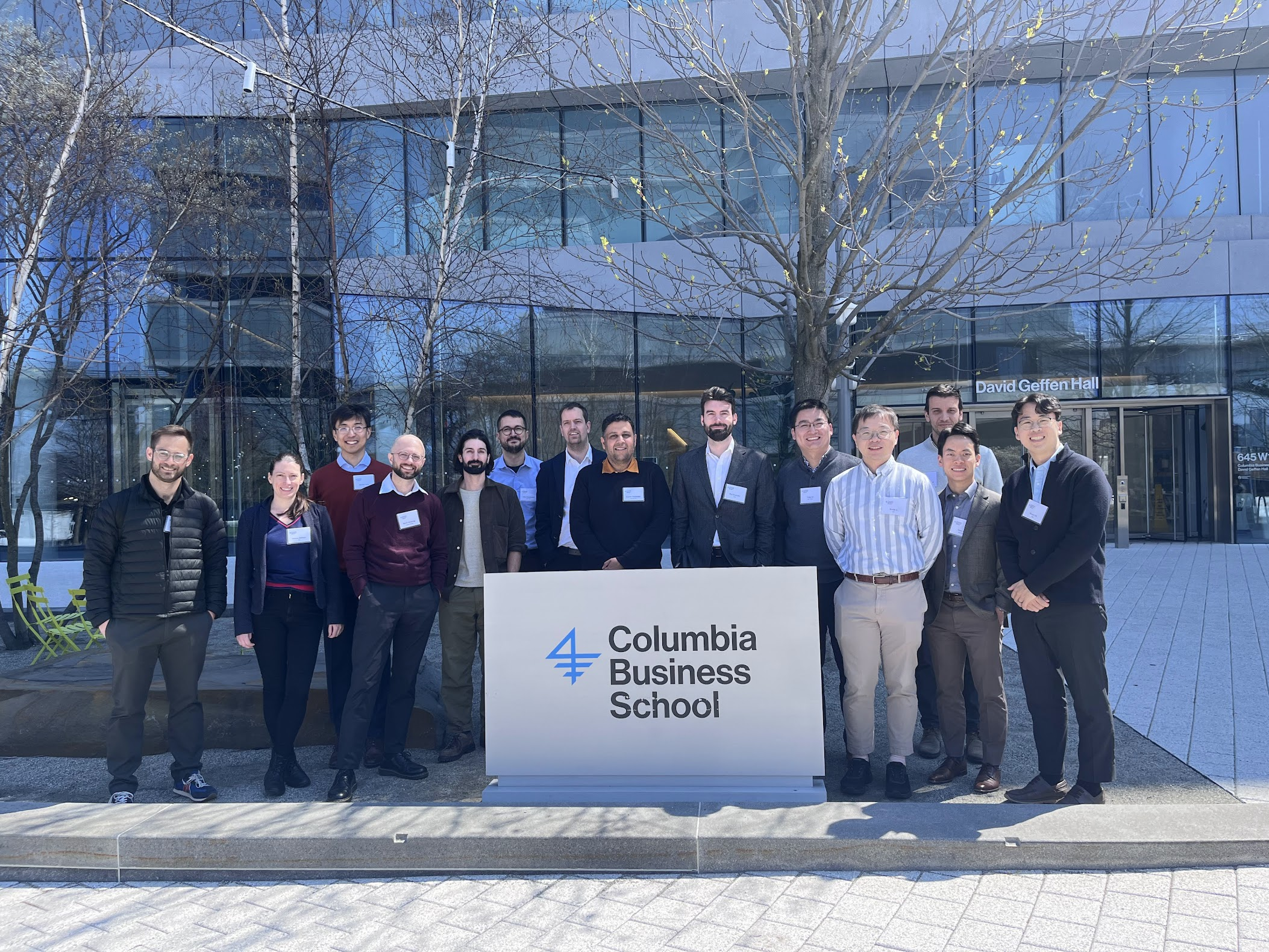
This year, we had each junior faculty recommend one person to invite, which resulted in a very nice session of 8 papers. You can find the program here: columbia-finance-workshop.github.io/2026.html.
Papers
- Hanbin Yang (LBS) presented “Default Options and Market Power: Evidence from Target-Date Funds,” joint with Marco Loseto. The paper starts from a simple but important observation that target-date funds are often the default option in retirement plans, and default status may give providers market power over inattentive or inelastic investors. They show that TDFs appear to charge meaningfully more than the underlying funds they package, and flows into TDFs are less fee-sensitive than flows into comparable non-TDF products. I liked the question because it takes a feature that is usually treated as welfare-improving, the use of defaults, and asks whether it also creates room for rent extraction. Much of the discussion turned on exactly where the inelasticity sits. Is it workers, employers, recordkeepers, or the plan committee? Once you start thinking about defaults as a market design choice rather than just a behavioral nudge, the IO of the retirement market comes into view much more clearly.
- Thomas Geelen (Penn State) presented “Old Workers, New Capital,” joint with Philippe d’Astous and Jakub Hajda. The paper asks whether there is a bright side to workforce aging, and its answer is that firms hiring older workers invest more. They use Canadian matched employer-employee data and a shift-share design to argue that older workers are more productive in a way that raises the return to capital and skilled labor, leading firms to invest more. I thought this was an interesting attempt to push against the usual pessimistic view that population aging mechanically depresses dynamism. At the same time, the paper raised a lot of questions about interpretation: is this really about age, or about experience? Is the key margin older workers specifically, or broader demographic change such as declining fertility and immigration? And how much of the result reflects who gets hired rather than what firms do after hiring them? Those are hard questions, but they are also the questions that make the paper worth engaging with, and the basic idea — that labor composition can shift firms’ capital demand in systematic ways — is a useful insight.
- Taha Choukhmane (MIT Sloan) presented “AI Financial Advice: Supply, Demand, and Life Cycle Implications,” joint with Tim de Silva, Weidong Lin, and Matthew Akuzawa. This was one of the most current papers on the program. The project studies what advice large language models give when households ask for personal financial guidance, combining a life-cycle model, a survey that elicits realistic prompts from a representative sample, and prompt randomization to separate demand from supply. The setup is clever, especially because it tries to discipline the exercise with actual household questions rather than toy prompts written by researchers. My main reaction was that one has to be careful about what exactly is being claimed. If the result is that LLMs often give advice that lines up with life-cycle logic conditional on the information they are given, that is interesting. But that is not the same as saying they give good financial advice unconditionally. In practice, household context is messy and prompts are often incomplete without much explicit guidance. Nonetheless, it is a very timely and important paper, and one of the better attempts I have seen to study AI advice using an economic framework.
- Gaurav Chiplunkar (UVA Darden) presented “Internet as a General-Purpose Technology: Evidence from Colombian Firms.” The paper asks how broadband adoption changes firm production, and its central point is that technology adoption works through multiple channels at once, affecting scale, input demand, and market access rather than just productivity in a narrow sense. The empirical setting is Colombian manufacturing, paired with a model meant to organize the interaction between these channels. Apparently, there is already a large literature showing that digital technologies matter, but much of it stays at the level of treatment effects. This paper tries to ask what broadband actually lets firms do in a much broader sense. The discussion pushed on exactly how broad the model should be and whether the empirical variation is ultimately still diff-in-diff style variation wearing more structural language. That I thought was a fair challenge.
- Tong Liu (MIT Sloan) presented “Going for Broker? Intermediation in Health Insurance Markets,” joint with Anran Li, Anthony LoSasso, and Nicholas Tilipman. The paper studies brokers in the employer-sponsored health insurance market, a setting that is economically large but surprisingly opaque. The central idea is that brokers may do more than match employers to plans but instead steer employers toward high-commission products and shape competition by limiting the set of insurers that effectively reach employers. The data effort is substantial, stitching together employer-insurer relationships, employer-broker relationships, contract networks, and commission schedules. What I found most interesting was that the paper treats intermediation as both an information problem and a market structure problem. If brokers are paid by insurers and also guide employer choice, then the right benchmark is not simply whether they reduce search costs but whether they distort product assortment and soften competition in ways that employers do not fully see. Several questions in the room pushed on what friction really sustains that equilibrium, and whether the paper can pin down why employers do not arbitrage across brokers or insurers more aggressively.
- Derek Wenning (Indiana Kelley) presented “From Long to Short: How Interest Rates Shape Life Insurance Markets,” joint with Ziang Li. This is a paper that sits squarely in my own research interests, so I was especially keen to see it. The starting point is the well-known observation that US life insurers built up large negative duration gaps after the GFC, and the paper asks what that mismatch does to the market for life insurance products themselves. The basic argument is that if insurers are effectively risk averse over their duration mismatch, then product prices should reflect that mismatch, penalizing long-term contracts and subsidizing short-term ones. They build a tractable model and then take it to statutory filings and monthly pricing data, contrasting VA issuers as the exposed group with non-VA issuers as a comparison. My main push, which Sean raised from a different angle, was that taking the duration gap as a state variable that then dictates pricing feels like one equilibrium of a broader joint problem. If the insurer is choosing assets and liabilities together, the duration gap is itself an outcome, and it would be worth seeing how much of the product-market adjustment survives when the duration becomes an explicit choice of the insurers. In any case, I like these papers that take institutional detail seriously and try to link it back to household welfare.
- Sean Wu (NYU Stern) presented “Banking on Inattention,” joint with Xu Lu. The paper builds a dynamic model in which deposit pricing is an intertemporal trade-off between the current spread and the future deposit base, with depositor inattention as the key friction. When inattention is higher, deposit outflows respond more slowly to a given spread, so the bank can sustain a larger wedge. When policy rates rise, inattentive depositors eventually start to notice, which generates sign-switching interest rate exposure of the deposit franchise. I found the framing useful, but the paper models the inattention parameter in reduced form that is isomorphic to any form of market power. So it left me with the lingering feeling that really gets closer to household behavior.
- Ray Kluender (HBS) presented “Mental Accounting for Credit: Evidence from a Large-Scale Credit-Limit Experiment,” joint with Sean Higgins. Working with Cashea, the largest consumer credit provider in Venezuela, the authors randomize 50% and 100% credit-limit increases across 210,000 users who each have two category-specific credit lines, an “Everyday Line” that works only at grocery stores and pharmacies, and a “Principal Line” for clothes, electronics, and home goods. Because the two lines are technologically non-fungible, the setting is close to a laboratory test of whether consumers treat credit as money that is truly interchangeable. Without mental accounting, almost any standard explanation (precaution, liquidity constraints, signaling) predicts meaningful cross-line spillovers. With mental accounting, the response should live mostly within the category whose line was loosened. I’m generally a big fan of Ray’s work using experiments, and in this case the scale was quite striking. A very fun paper to end the day on.
Takeaways
- This year I offered to take notes on every presentation, writing down the comments and questions from the room and sending them back to each presenter afterward. It is a small thing, but it made me listen harder than I otherwise would have. I also think it is a nice service to the authors, especially when there are eight papers in a single day and the memory of the morning’s discussion has already started to fade by the coffee break.
- In my relatively short time as an academic, the junior finance workshop has become a special place, both because of the intellectual quality of the papers and because of the community it has built around them. And a lot of that is possible because Columbia has made it remarkably easy to organize. The finance division staff deserves A TON of credit with all the logistics and the hundred small things that make an event like this run smoothly.