Conference Recap: ESSFM 2025 — Asset Pricing
This entry pertains to the European Summer Symposium in Financial Markets (ESSFM) 2025 — Asset Pricing. The conference was held at the Study Center Gerzensee, a scenic Swiss village near Bern.
Introduction
Gerzensee is small, quiet, and very green, which turned out to be ideal for keeping everyone focused.


The schedule followed a consistent rhythm: morning sessions of three papers (about 3.5 hours total), an evening session of three papers (about 1.5 hours), and structured lunch/dinner slots. Afternoons were mostly unscheduled, meaning people either worked, hiked, or played soccer.
I was sad that my coauthor Federico could not make it, but this gave me some time for one-on-one conversations. The smaller size of the profession at Gerzensee means you get to know each other quickly, both the research and the quirks.
Paper Sessions
Here is a summary of the sessions I attended (which is pretty much every session except for Friday where I fell sick):
- Mete Kilic presented “The Fed and the Wall Street Put” which studies how different investors trade S&P500 index options around FOMC meetings. They find that proprietary trading firms act as net sellers of options on announcement days, in contrast to their behavior on other days.
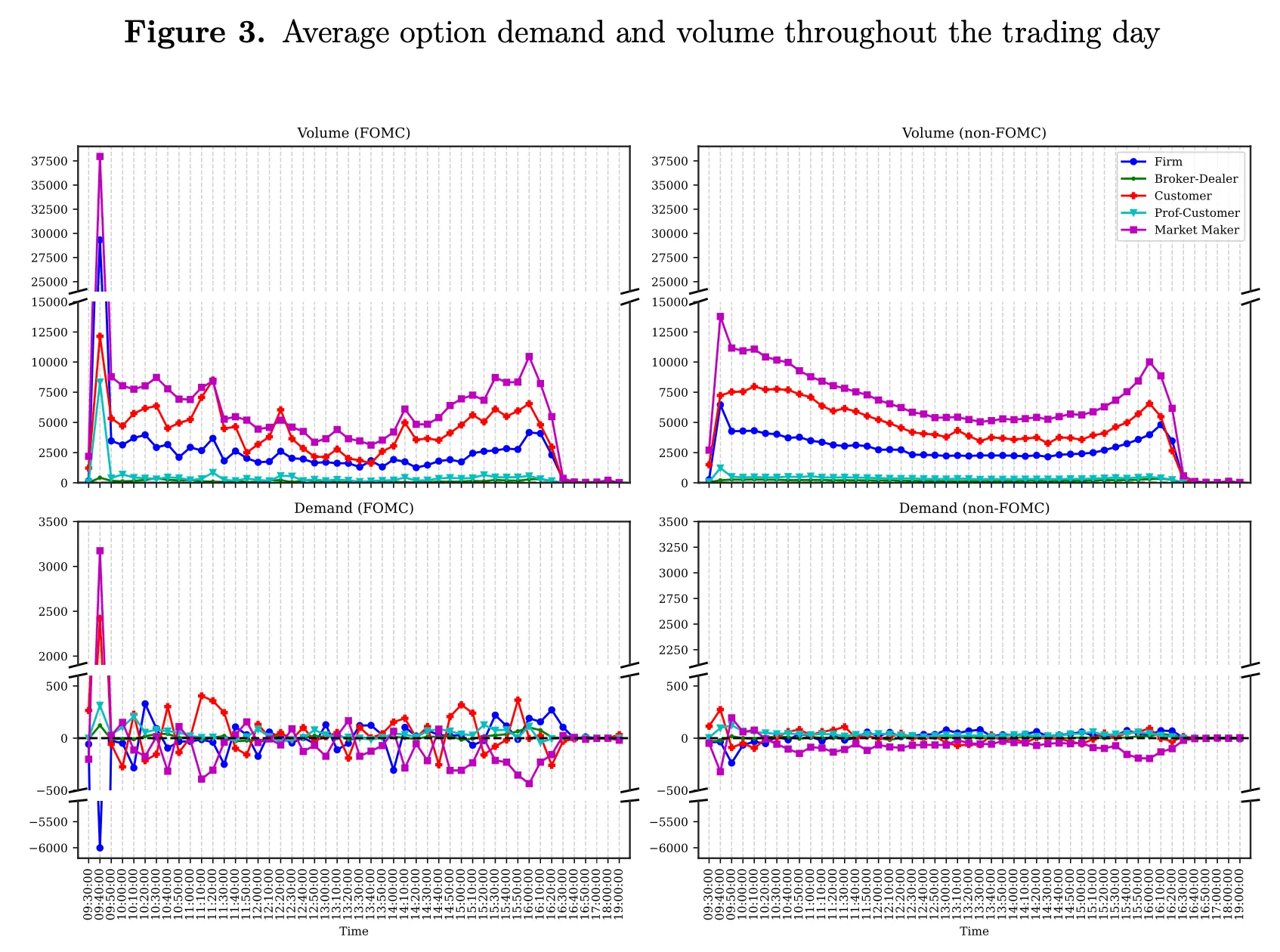 Discussant Sebastian Hillenbrand suggested a few alternate empirical tests and whether equities alone is the right asset class to look at. Personally, the most interesting part of the paper is distinguishing between (i) predicting the policy announcement itself or (ii) predicting the market reactions to the policy announcement.
 - Christian Skov Jensen presented “The Cyclicality of Risk and Risk Premia” which studies the ratio of conditional risk premium to variance. They show that this ratio (1) pins down the conditional beta in a regression of the SDF onto the market return, and (2) this ratio is weakly procyclical, unlike the Sharpe ratio. My takeaway from the paper is that different asset markets are more amenable to different representations of the risk-return relationships, and the one offered by the authors is more appropriated for certain markets like options and equity term structure.
- Indira Puri presented “Certain vs. Uncertain Timing: Financial Markets and Pricing Implications” which I already had seen at the NBER SI. But it helped to see it once more. My biggest question is whether it’s possible to give an option to wait to the participants in the experiment that the author ran. This is also what the discussant Quentin Vandeweyer brought up in his discussion.
- Vadim Elenev presented “Interest Rate Risk and Cross-Sectional Effects of Micro-Prudential Regulation” which presents a two-period model that rationalizes the cross-section of bank portfolio and funding choices. A key stylized fact that serve as motivation is that less loan-productive banks are mainly in deposit business and use bonds to back insured deposits, while the more loan-productive banks grow using uninsured deposits and hold bonds against run risk. They also show that size-dependent capital requirements reduce run risk with fewer side effects than equal capital requirements or liquidity regulation.
- Alexi Savov led the focus session on “Credit Markets and the Economy” and presented “Monetary Policy and the Mortgage Market” that talks about how one area where MP had a clear and strong impact is the mortgage market. The paper convincingly paints a picture of how central mortgage markets are to the transmission of monetary policy.
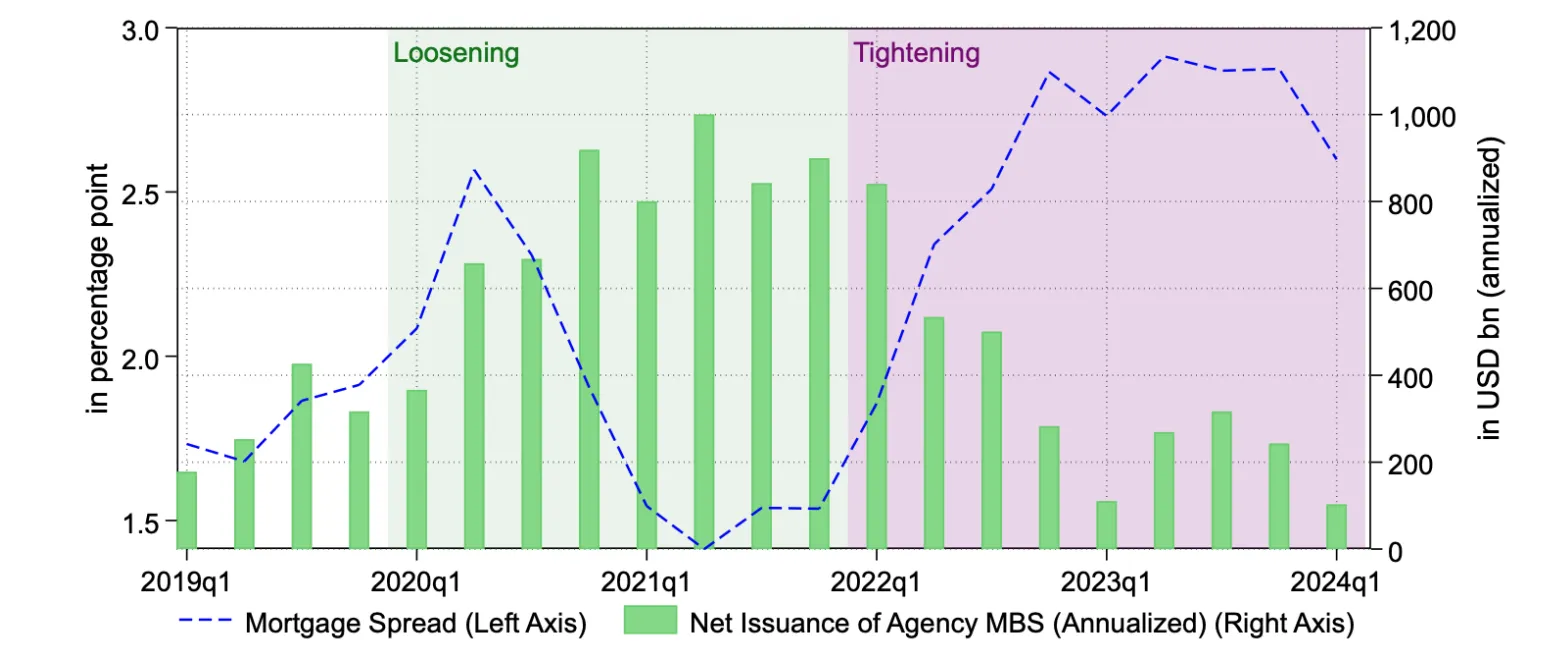 The key idea is that monetary policy shifts the supply of mortgage credit by the two largest mortgage holders: banks and the Fed. For the Fed, this is due to QE and QT. For banks, authors show that it is due to the deposits channel of MP. Note that this is “supply” because buying an MBS is functionally equivalent to providing funding for the underlying mortgage loans, so investors in MBS (including the Fed) are suppliers of credit to the mortgage market.
 - Leonardo D’Amico presented “Capital Market Integration and Growth Across the United States” which was his job market paper (and one I saw at Columbia during his flyout). I like his paper a lot because the paper’s centered around a core message on how nominal short rates can serve as an impetus for financial integration (convergence). An obvious question is whether this converge is a good thing or not, and I’m sure he’s already onto this question in a follow-up project.
- Antoine Hubert De Fraisse presented “Crowding Out Long-Term Corporate Investment: The Role of Long-Term Government Debt Supply” which studies the real effects of variation in the maturity structure of government debt.
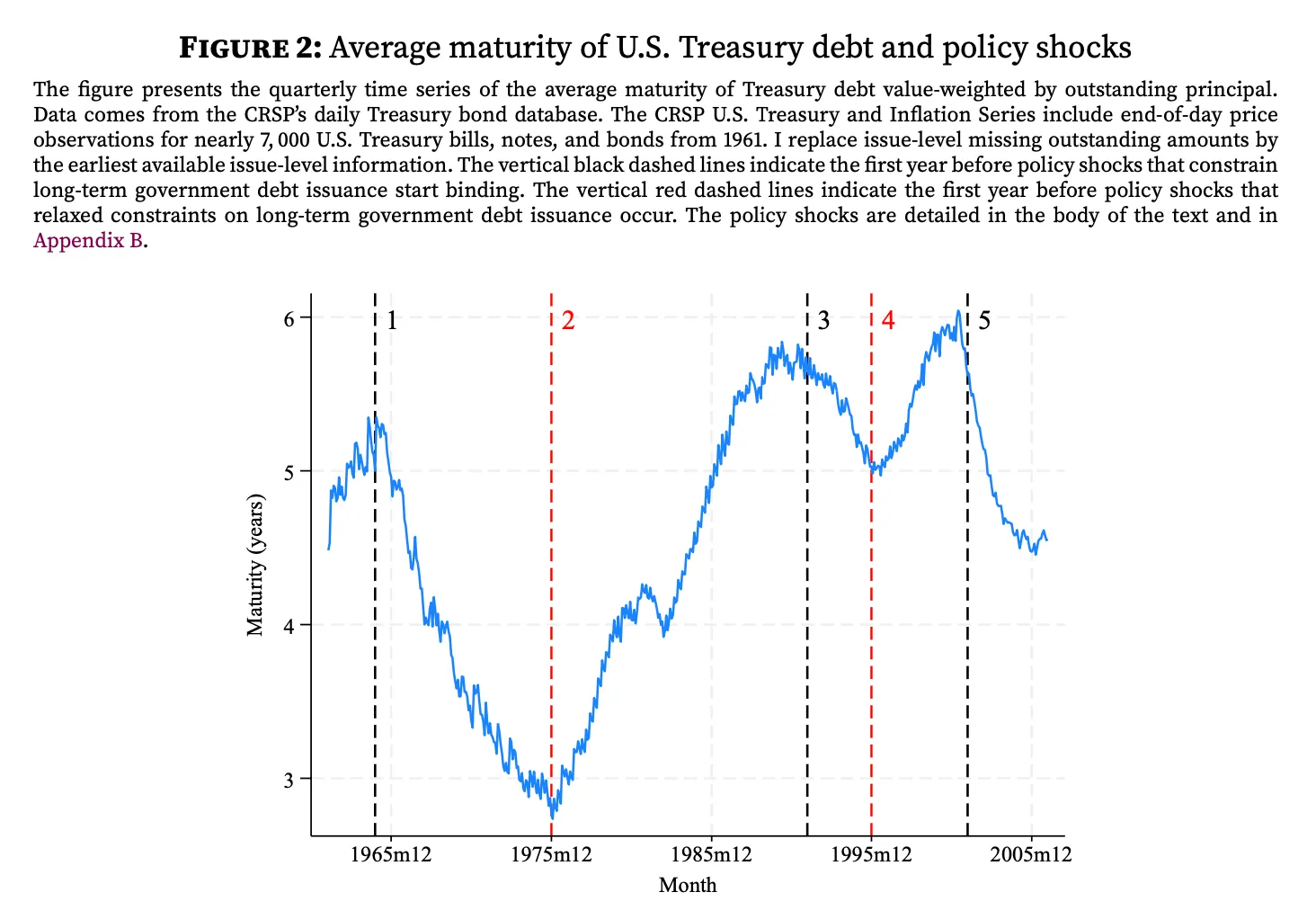 The key finding is that the maturity structure of government debt affects the duration of corporate investment.
 - Maryam Farboodi presented “Equilibrium Spillover of Big Data” which studies the equilibrium market structure in a world where lenders leverage big data technology. The key result that Maryam emphasized is the hockey-stick interest rate schedule, which is a result of non-assortative matching between lenders and borrowers.
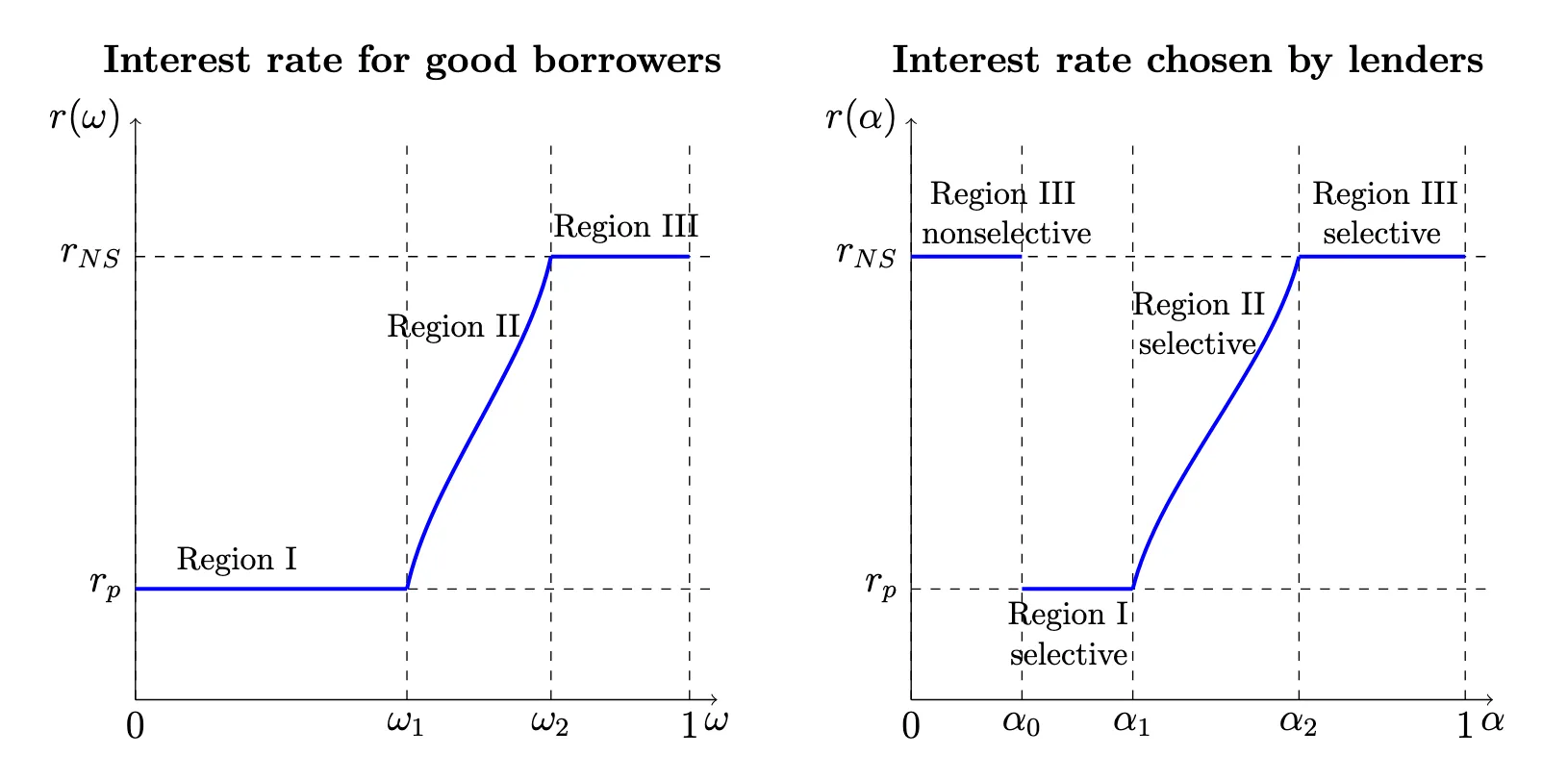 The discussant Zhiguo He helped us all appreciate the theoretical contributions of the paper as well as the need for additional empirical checks.
 - Semyon Malamud presented “Complex Rational Expectations Equilibria” which presents an equilibrium model where agents use ML. He started off the presentation with how continuous finance became a staple of asset pricing through Ito’s Lemma, and he said his paper uses a similar simplification technique that makes things very tractable. The broad takeaways are: (1) being Bayesian in a high complexity environment is sub-optimal, and (2) in ML, small eigenvalues are important.
- Lu Liu presented “Mortgage Structure, Financial Stability, and Risk Sharing” co-authored with Vadim Elenev. The key innovation of the paper is to make deposit-taking institutions (a.k.a. banks) the marginal agent for pricing default risk of mortgages. Konstantin Milbradt delivered a good discussion where we points out some gaps in the model including the lack of a lock-in effect and the fact that the mortgage market clears while the deposit market does not.
- Philippe van der Beck presented “Implications of Portfolio Flows and Returns for Asset Pricing Models” which formalizes the trade-off between elasticity and disagreement to derive an empirically relevant bound on price impact. I like the paper quite a bit (not to mention its relevance for a paper of mine), and Philippe’s presentation is always fun to listen to.
- Sebastian Hillenbrand presented “Cash Flow Volatility, Return Predictability and Stock Price Decompositions: Why You Should Scale Prices by Trend Cash Flows” who shows that Cochrane’s famous result on discount rates is sensitive to the specification, and that cash flow volatility is important for the (1) slope and the (2) decomposition results. One question I had is where these changes in cash flow volatility comes from, and to what extent this is mediated by how corporate finance has changed vs. the more deep structural parameters of the economy.
- Kai Li presented “Allocative Efficiency of Green Finance Instruments” which evaluates a myriad of green finance instruments focusing on one salient feature: the timing of financial mechanisms. The key idea is that ex-post measures inadvertently direct dirty capital towards financially constrained firms, highlighted in an impactful paper by Hartzmark and Shue (2023). But ex-ante approaches do not suffer from this shortcoming, so we should be careful to readily extend the conclusion from Hartzmark and Shue (2023) to other green finance strategies.
- Valentin Haddad led the focus session on “Market Macrostructure” and presented “Asset Purchase Rules in the Euro Area and their Effects on Bond Markets.” The presentation of the “Market Macrostructure” was very useful and I wish I had access to it when I was on the market, especially as I was writing the research statement (at least for my own internal clarity of thought). The paper on QE focused a lot on the Euro Area, and I was wondering to what extent the findings would change if the intervention was done by someone outside the Euro Area.
- Paul Huebner presented “Causal Inference for Asset Pricing” which I saw Val present at the NBER. I also read one of the earliest versions of the paper before it was public, so it was illuminating to see how the paper had evolved over time. There were a lot of questions from outside the audience in demand system asset pricing, questioning the stringency of the assumptions and whether it’s better to just move away from demand-supply approaches in asset pricing.
Takeaways
- It’s easy to take a well-run conference for granted, but Gerzensee is a logistical miracle. Every morning session started on time, every discussant was sharp, and the whole thing had the air of being effortless — which of course means it required a ton of work behind the scenes. I’m very grateful to the organizers, Lukas Schmid and Lorenzo Bretscher, and the Study Center Gersenzee for pulling it off.
- Another thing I appreciated was the chance to ask people more personal questions about their research. For a course I’m teaching, many students ask not “what’s the result?” but “how did they come up with the idea?”
 Gerzensee was the perfect place to ask exactly that, and the conversations gave a different perspective on the production process behind the papers.