Conference Recap: ESSFM 2025 — Banking and Corporate Finance
This entry pertains to the European Summer Symposium in Financial Markets (ESSFM) 2026 — Banking and Corporate Finance. The conference was held at the Study Center Gerzensee, a scenic Swiss village near Bern.
Introduction
This was my second year at Gerzensee and my first on the banking and corporate finance side, after last year’s asset pricing meeting. The symposium was organized by Zhiguo He.
I experienced the misfortune of my laptop breaking down on Tuesday, so I had to prepare my night time presentation on my iPad. But it was also a cherished opportunity to write the manuscript of my drafts by hand (which apparently is good for your brain) and explore outside the area a bit more this time via biking and hiking.



Paper Sessions
Here is a summary of the sessions I attended (which is pretty much every session except for half of Monday morning where I arrived a bit late):
Monday: New Issues in (Old) Corporate Finance and Banks
- Yuri Tserlukevich presented “Corporate Hedging, Contract Rights, and Basis Risk” (with Ilona Babenko). The paper points out that standard hedging theory treats a derivative as protection the firm holds to maturity, but in practice OTC derivatives sit under ISDA Master Agreements whose eight standard events of default allow the counterparty to close out the position early. In other words, the hedge can be pulled away exactly when it is most needed and this can also explain the puzzle that distressed firms appear to hold low hedge ratios.
-
Erica Jiang presented “Real Origins of Financial Structure: The Role of Household and Firm Heterogeneity” (with Greg Buchak), which asks whether household and firm composition can explain why financial systems differ across countries and over time. The punchline of the paper is that demographic differences explain the savings side but not the borrowing side. There were some discussions about who owns the firms in the model and whether households wealth includes them and what actually generates the heterogeneity if you are only imposing different wealth levels. Of course, the larger looming question is how much additional \(R^2\) this buys us on top of the usual suspects of regulation, technology, and institutions. Tuesday: Bank and Nonbank
- Amit Seru delivered a nice opening session on the symbosis of banks and nonbanks.
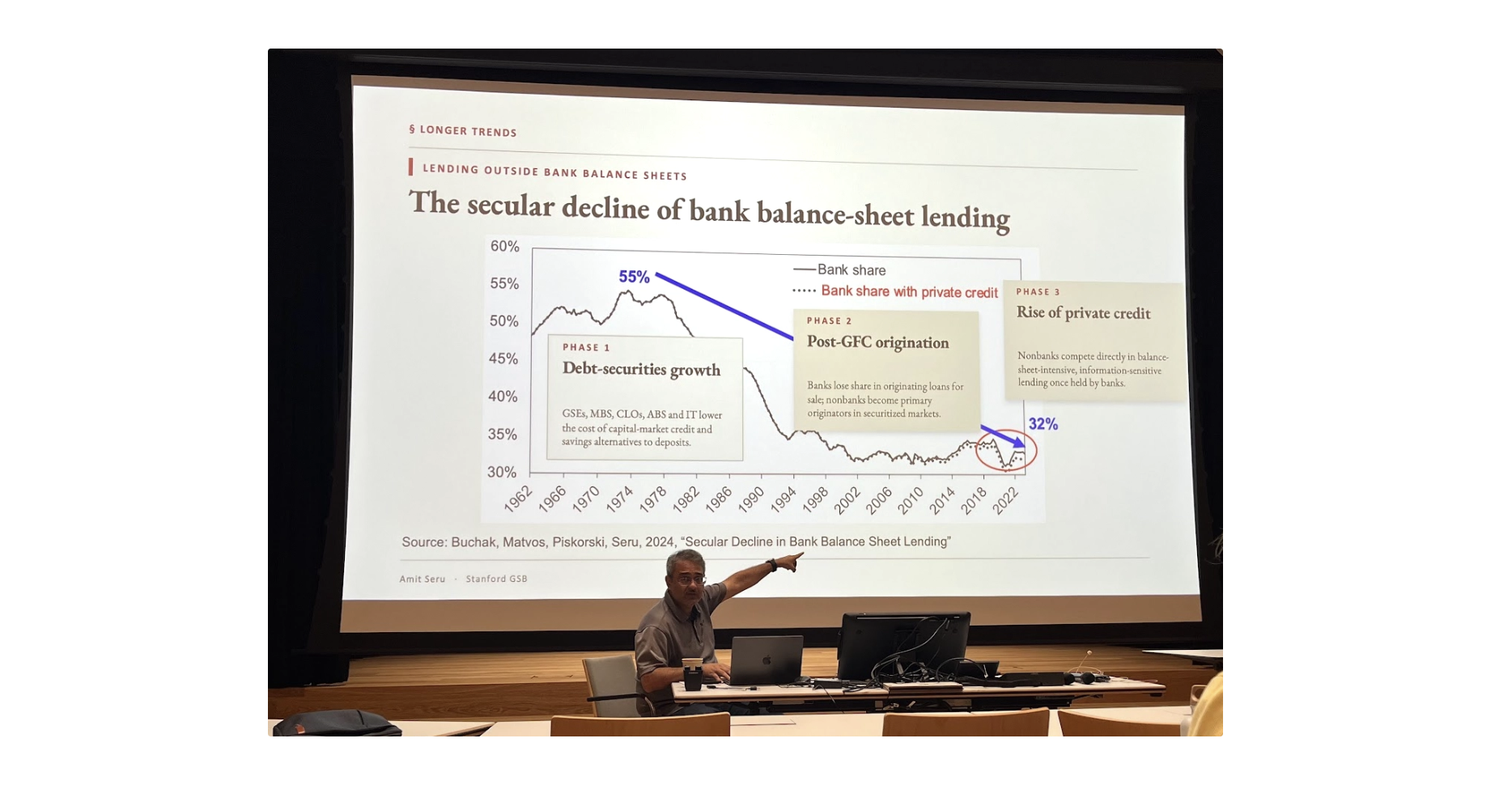 The textbook view is bank-centric where savers hold the resources but cannot find the users, so the banks can step in to intermediate. He showed that the bank balance-sheet share of U.S. lending fell from 55% to 33% over about 50 years, but even adding private credit moves the bank share only minimally. All of this was to say that private credit is definitely real and interesting, but the secular shift out of bank balance sheets is much older than that.
 - Dominik Supera, my colleague at Columbia, presented “Bank to Non-Bank Lending and the Reallocation of Credit” (with Jian Li, Yiming Ma, and Caterina Mendicino). The authors document that there has been a rapid growth of euro-area bank lending to NBFIs since 2019, and that this happened mostly through reverse repos (which fund government-bond collateral) hence “crowding out” firm lending. Ben Hebert made a fair point that while the compositional evidence is convincing, the aggregate crowding out claim needs a GE assumption that was never made explicit (i.e. the pool of savings intermediated by banks). Ricardian equivalence probably doesn’t hold in practice, but still it would be nice to have the logic be airtight.
- David Xu presented “Credit Commitments by Nonbanks” (with Jing Huang), which hand-collects facility-level data on BDC commitment books and shows that BDCs now issue credit commitments at commitment-to-asset ratios comparable to banks. Interestingly, they manage the resulting liquidity risk not with cash but with their own undrawn bank credit lines, so liquidity insurance runs in two layers along the credit chain. My question was whether this is really about BDCs or just about any firm-facing nonbank writing commitments without a public backstop.
- Paul Rintamäki presented “PIK Now and Pay Later: How Deferred Interest Reshapes Private Credit” (with Sascha Steffen), which argues that payment-in-kind (PIK) provisions act as a contingent-liquidity substitute for the credit lines that private credit borrowers do not have. Exercising PIK raises the probability a loan turns delinquent next quarter by 1 to 2 percentage points against a 3% unconditional rate. The part I found most interesting was the agency layer: because the BDC manager earns fees and avoids restructuring effort whenever a loan continues without technical delinquency, PIK opens a forbearance band where loans that should be restructured get over-marked instead. Gordon Phillips asked the useful historical question of why BDCs hold these now when banks used to, and the answer was that post-GFC rules pushed PIK off bank balance sheets.
- Tetiana Davydiuk presented “Common Investors Across the Capital Structure: Private Debt Funds as Dual Holders” (with Isil Erel, Wei Jiang, and Tatyana Marchuk), which documents that 80 to 90% of BDC-years include equity positions, so the same vehicle is often both creditor and shareholder of a portfolio firm. Dual-held loans carry a 45bp premium within firm-quarter, and the mechanism appears to be delegated monitoring rather than risk pricing or hold-up. Figuring out why they offer equity is a challenging task since equity can be also read as a cost reduction offered to the BDC rather than monitoring. The answer in the paper is that with equity spreads on the firm’s other, non-dual-held loans fall by 16 to 40bp, and its overall cost of capital falls, and this positive spillover is more indicative of a “public good” provided through monitoring.
Wednesday: (Various Aspects of) Banking
- Tanja Brieden presented “Why Bank Net Interest Margins Are Stable: Insights from the Asset Side,” her job market paper, which offers an asset-side explanation for a puzzle usually answered on the liability side. Decomposing the interest income rate into a bank-specific risk-free benchmark and an implied credit spread, she shows the benchmark is highly rate-sensitive at about 58bp per 100bp, so NIM should move a lot. What stabilizes it is that credit spreads move counter to policy: a 100bp cut is associated with a 24bp higher implied spread, and this holds within loans and within securities rather than through asset-class shifts. In other words, banks keep NIM stable by trading interest-rate risk for credit and duration risk. The implication for stress testing, that interest-rate risk should not be assessed in isolation from other balance-sheet risks, seemed right and under-appreciated.
- Konstantin Milbradt presented “Interest Rate Risk and Bank Hedging” (with Zhiguo He and Arvind Krishnamurthy), which asks how a bank should hedge when rates drive cash-flow risk and discount-rate risk at the same time. Optimal hedging stabilizes the marginal value of cash to bank equity, and the bank hedges away all interest-rate risk only on the knife edge where the deposit-rate, loan-rate, and deposit-growth betas are all zero. Otherwise it retains exposure, trading off stabilizing its leverage ratio against exploiting a shifting investment opportunity set. Some questions from the audience were whether the exogenous dividend assumption kills the leverage ratchet effect, what happens with runs, and why capital requirements are needed at all when most of the interesting economics seems to happen away from the constraint.
- Ben Hébert presented “Deposit Competition Beyond Rates” (with Matteo Benetton and Tim McQuade). Banks pay almost nothing on retail deposits and pass through almost none of a rate increase, which is usually read as market power. But banks do compete, just not on rates: they mail cash sign-up bonuses, and the data here covers about 2,200 mail campaigns from 11 large banks holding roughly half of US deposits. An interesting takeaway from the paper is a pecking order to the bank’s decision. Mailing has constant marginal cost, raising the bonus has increasing marginal cost because you must pay inframarginal switchers too, and the interest rate is the most convex tool of all because you have to pay everyone. So banks flex mail volume, not price. A 100bp higher fed funds rate raises bonuses by only about $16 but mail volume by 11%. One point that kept lingering with me is the role of banks’ interest rate expectations — the franchise value is a positive-duration asset, so a persistent rate rise lifts spreads but also lifts the discount rate and rivals’ offers, muting the net effect.
- Anastassia Fedyk presented “Technology in the Banking Sector and the Importance of Modern Skills” (with Efraim Benmelech, James Hodson, Vladimir Mukharlyamov, and Dimitris Papanikolaou), which measures not just whether bank employees have technical skills but the vintage of those skills, classifying them as modern or old using Google Trends search interest. The average bank’s technical capital grew about 84% over the 2010s. The result is that having technical skills does not protect a career, but having current ones does, and the benefit rises with age. The soft-skills placebo I thought was a nice touch, since modern soft skills correlate with worse outcomes. My question was that it would be useful to sort people on how good they are at acquiring new skills, in addition to the vintage of the skills they happen to hold.
Thursday: Technology, Firm Dynamics, and the Future of Work
- Victor Lyonnet presented “Why Don’t Old Firms Do New Things?” (with Zhiguo He, Nicolas Crouzet, and Yueran Ma), which asks when new technologies require new firms. The framing I liked is that Coase’s literature asked which transactions can be implemented inside a firm, and this paper asks which ideas can be. The mechanism is workstyle: each occupation carries traits, a new business model implies a different occupation mix, and a bigger workstyle gap means more conflict with the rules an old firm has codified. Very relevant to contemporary debates and interesting to think about.
- Larry Schmidt presented “Technology and Labor Displacement: Evidence from Linking Patents with Worker-Level Data” (with Leonid Kogan, Dimitris Papanikolaou, and Bryan Seegmiller), which separates labor-saving from labor-augmenting technology by measuring textual similarity between patents and an occupation’s routine versus non-routine tasks, then links exposure to Social Security earnings records. Labor-saving exposure at the 90th percentile costs 2.5pp of earnings over five years and hits everyone roughly equally, essentially unrelated to worker skill. However, labor-augmenting exposure hurts less on average but selectively, concentrated among older, higher-paid, white-collar workers.
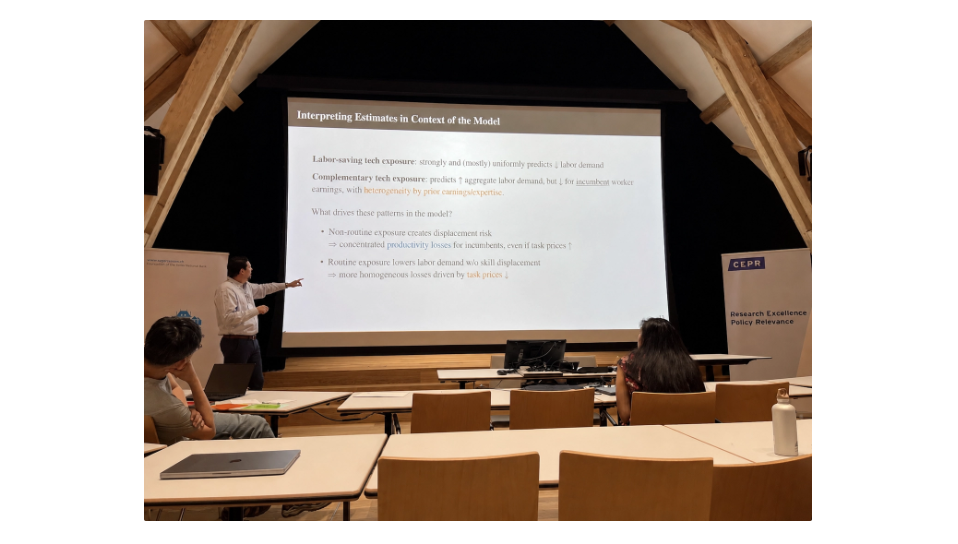 So you have this divergence where labor-augmenting innovation raises occupation-level employment and wages while cutting the earnings of the experienced workers whose human capital was tied to the old vintage, because the gains go to new entrants. Both “technology helps workers on average” and “technology hurts incumbent workers” are true at once.
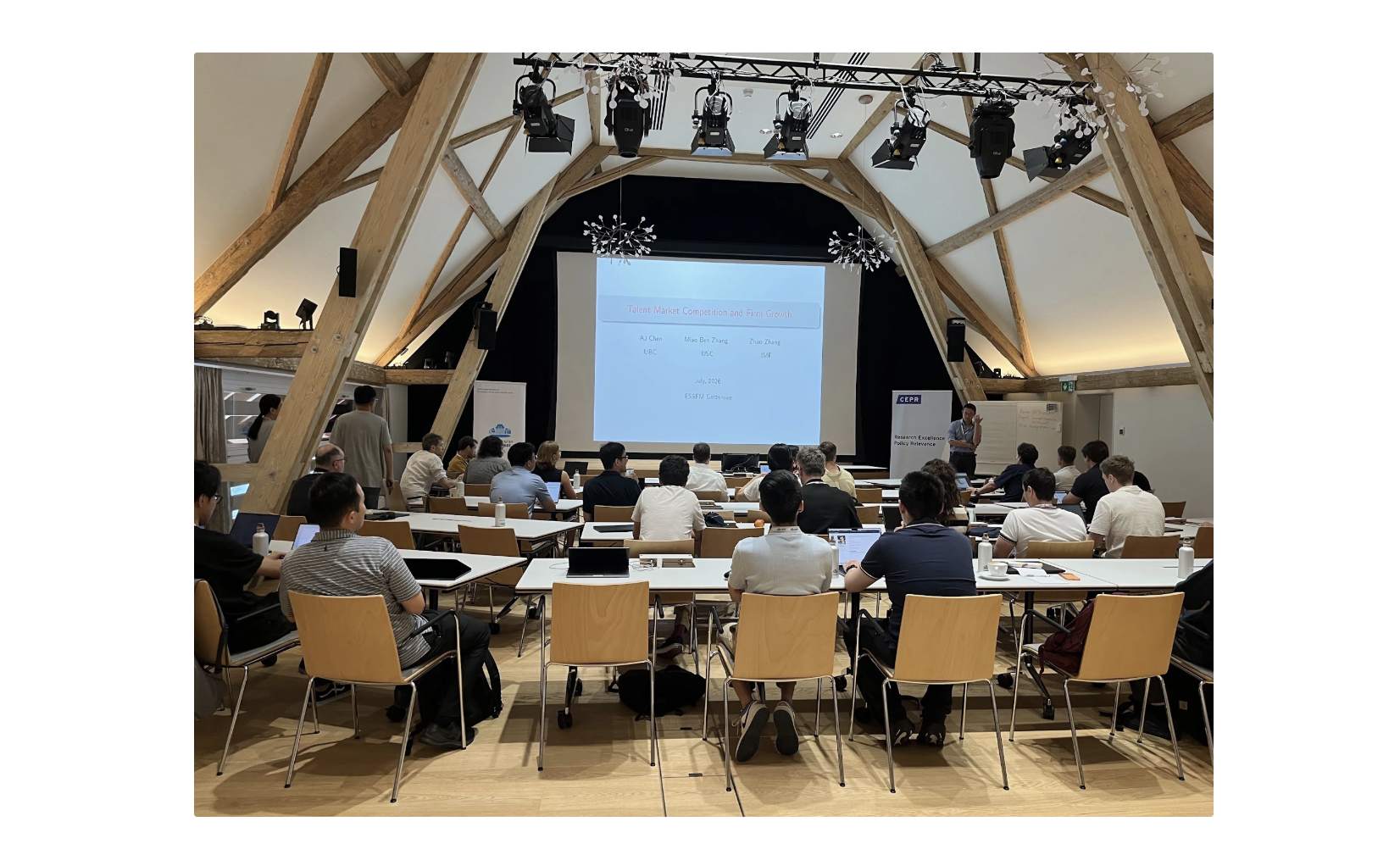
 - Miao Ben Zhang presented “Talent Market Competition and Firm Growth” (with AJ Chen and Zhao Zhang), which builds a firm-level measure of talent-market competition from vacancy-to-employment ratios in the firm’s talent occupations, excluding its own postings. Higher competition lowers subsequent investment, and it dampens laggards but not superstars, who retain talent more responsively and bleed less. The relationship to Fernández-Villaverde, Yu, and Zanetti on defensive hiring came up, where incumbents hire researchers partly to deny them to entrants. It is the same divergence with the opposite channel, and it points at a measurement wedge, since reading rivals’ postings as genuine outside options overstates them if a meaningful share are defensive.
-
Gordon Phillips presented “Collaborate or Consolidate? A NLP Text-Mining Analysis of R&D Networks and M&A” (with Chih-Sheng Hsieh, Michael König, and Jakob Rauch), which text-mines over 1.5 million news articles plus 10-Ks to extract R&D alliances, then embeds them in a network-formation model that also includes M&A. The finding that matters is that firms substitute R&D collaborations for M&A, so the two cannot be studied separately, and ignoring the joint endogeneity biases estimated spillovers upward. Past collaborations and shared partners lower the cost of both collaborating and acquiring, so basically alliances pave the way to acquisitions. Friday: Incentives Everywhere, Good or Bad
- Shohini Kundu presented “Regulatory Arbitrage Within the Firm” (with Nicola Cetorelli), which uses the phased implementation of Basel III from 2015 to show that BHCs recapitalized their bank subsidiaries by extracting equity from nonbank affiliates, with no increase in consolidated capital, assets, or lending. My first reaction was that the result is close to a prior, since moving capital to the binding constraint is what internal capital markets are, and “consolidated equity unchanged” is nearly an accounting identity absent external issuance. One question is whether nonbank affiliates are really unconstrained, since broker-dealers face SEC net capital rules and insurance subsidiaries face NAIC risk-based capital. The clean test is whether the extraction concentrates in asset managers and finance companies, which are genuinely unconstrained, and is muted elsewhere.
- Chuck Fang presented “Unrealized Trading Gains: Regulatory Limits to Market Elasticity.” The question is Duffie’s, namely why arbitrage capital is slow-moving, and the his answer is that an insurer sitting on unrealized losses must mark them to market if it trades, so trading against a fire sale carries a hidden capital cost that held-to-maturity treatment otherwise shields.
- Matheus Moura presented “Like Magic: Reducing Consumer Credit Risk with Non-Pecuniary Incentives” (with Artashes Karapetyan, Lars Norden, and Gabriel Barthman), which studies a Brazilian lender offering consumers a choice between a standard contract and an incentive contract carrying a lower rate but with repayment riding on the electricity bill, so missing a payment gets the electricity cut. The best question from the floor invoked the idea that since default supplies the missing contingency and the welfare-optimal default penalty is interior rather than zero or infinite. That bites here because the cutoff is a deadweight penalty from which the lender recovers nothing, so a 20% default reduction is only unambiguously good if the averted defaults were inefficient.
- Peter Koudijs presented “Holding Bankers Liable: Personal Guarantees and Risk-taking in Security Underwriting” (with Eva Mulder), which uses a historical Dutch bank setting to study how downside exposure for bankers limit risk-taking for banks. This is a pre-1933 setting where bankers had to personally guarantee bank underwriting, based on records from a Dutch bank, which I can only imagine takes incredible amounts of careful data work.
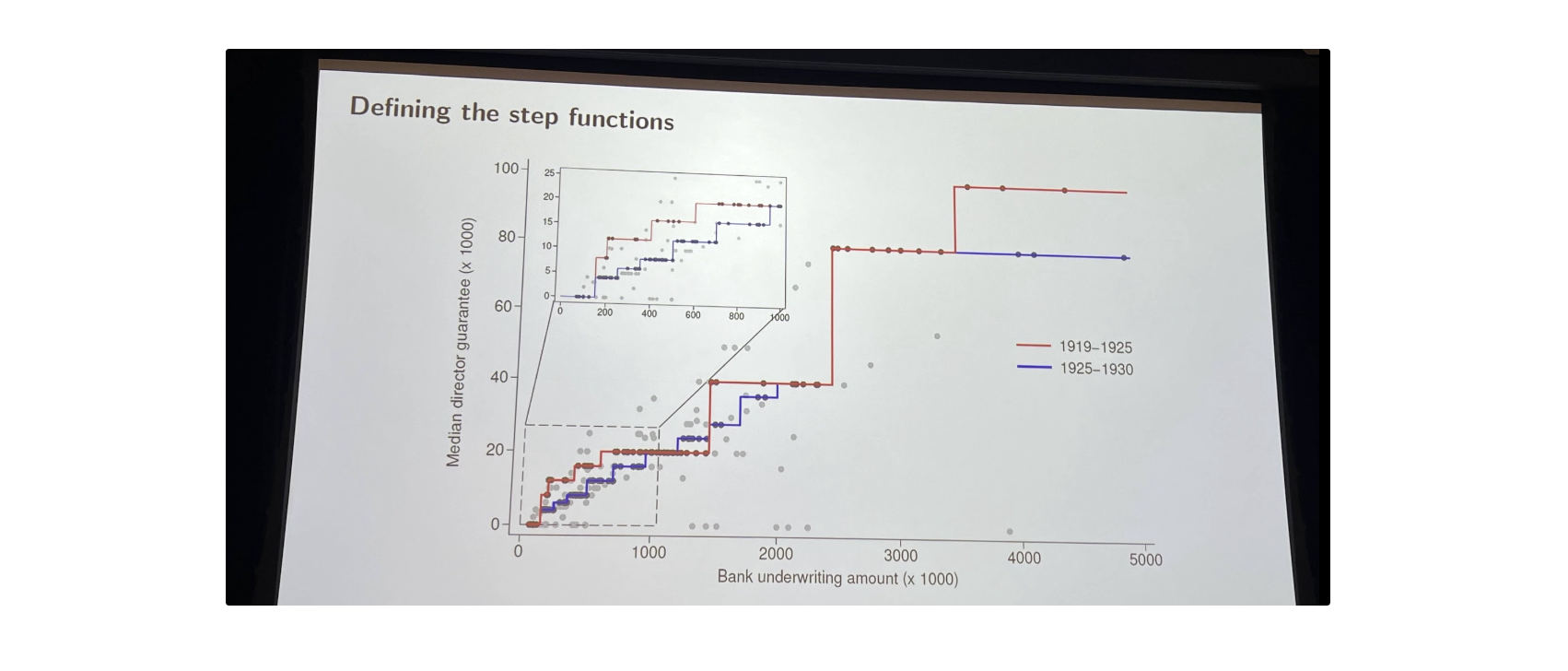 Overall they find the downside exposure to be quite effective, and their methodology is interesting because in their first step they have to first infer the exposure rule based on noisy historical records, which is then used as an instrument.
Takeaways
- Gersenzee remains one of my favorite conferences to attend. It helps that the mornings start on time, the audience pays full attention to the papers, and the afternoons were free. The night sessions were all very well attended.
- I think the focus-session format deserves more imitation. Opening each session with the framing rather than a paper meant the four papers that followed were heard as answers to a stated question.
- Last year I noted that Gerzensee is a good place to ask people how they came up with an idea. That was true again this year, and the answers were, if anything, more useful on the banking side, where the binding constraint is so often getting access to a supervisory dataset.