Conference Recap: Firms’ Cost of Capital, Discount Rates, and Investment Conference (May 16-17, 2024)
Starting with this post, I intend on briefly summarizing the talks and panels at the conferences that I attend. My hope is that this will help me keep track of the many conferences to come and also incentivize me to pay more attention during the talks.
For this first entry, I’ll be covering the Firms’ Cost of Capital, Discount Rates, and Investment Conference held at The University of Chicago on May 16-17, 2024.
Introduction
The conference touched on various aspects of the cost of capital and discount rates. These rates are vital for investment decisions as they determine the present value of future cash flows. To understand what influences discount rates, it’s useful to consider three main factors: (i) financial markets and risk premia, (ii) inflation, and (iii) macroeconomic policy. Financial markets and risk premia reflect the return investors demand for taking on risk. Inflation impacts the real value of future cash flows, while macroeconomic policy can influence both inflation and overall economic conditions. By exploring these factors, the conference provided a comprehensive view of how discount rates shape investment strategies and economic outcomes.
Part 1: The Cost of Capital Channel
- Masao Fukui explained how nominal discount rates remain sticky when expected inflation changes, causing real discount rates to move in the opposite direction. As a result, movements in expected inflation become linked with investment decisions, and monetary policy that affects expected inflation (e.g. inflation target) becomes more effective. Under the assumptions of their model, any toolkit that can target expected inflation would be able to stimulate aggregate investment. [paper link]
- Matt Rognlie described a model that can explain both “humps” in the aggregates and the “jumps” in the micro data. He also had a nice diagram of explaining the evolution of models in monetary economics and what each ingredients gets (and does not get) you. Inattention of households is the main modeling ingredient in this paper, and it helps you match the macro time-series. It turns out that when the level of inattention is estimated to match the macro moments, it is very large, and as a result the direct effect of interest rates on consumption is very small. [paper link]
- Larry Schmidt argues that fluctuations in risk premia leads to fluctuations in earnings risk for workers. Importantly, it disproportionately affects lower-income workers because the benefits of employment are more back-loaded for lower-income workers. [paper link]
- Annette Vissing-Jorgensen talked about her work that estimates the equity premium over daily forward periods up to one month in the future. In other words, standing on Day 1, she estimates the daily equity premium from day 1 all the way to day 30, which allows you to construct a figure like the following:
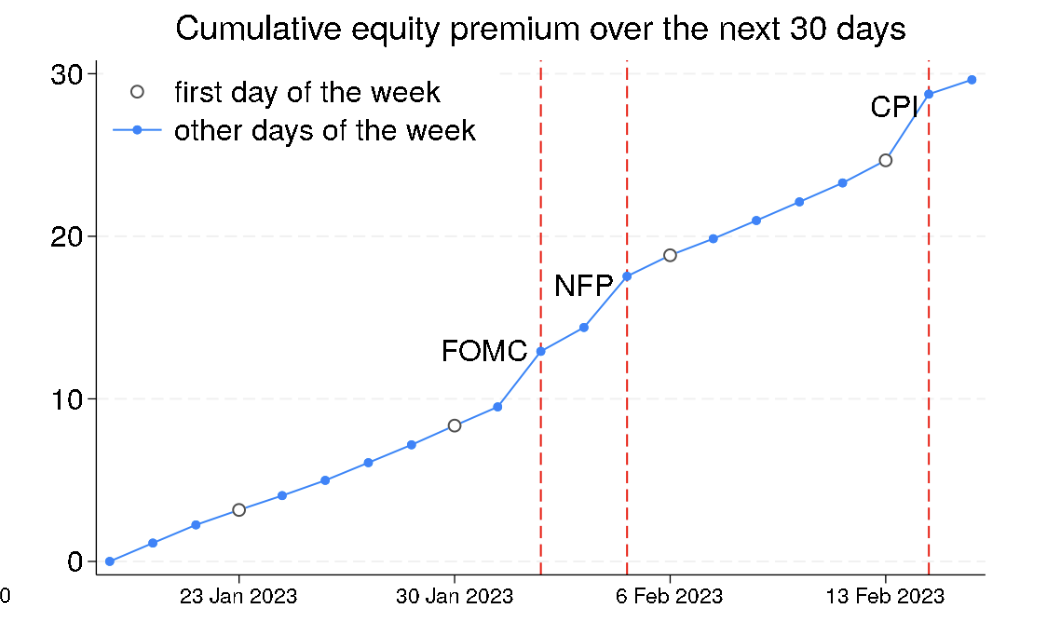 It would be interesting to see if there are any days that have elevated forward premium but are not associated with news releases. I was happy to see us get closer to the old question imposed by Richard Roll in his presidential address. [paper link]
 - John Graham discussed a new paper that looks at the DCFs constructed by analysts in their equity reports. The nice thing about this data is that it contains information on the terminal growth rate of cash flows that analysts use, which is different from the long-term growth rate (LTG) available from I/B/E/S data and new to the literature.
Part 2: Sustainable Investing, Cost of Capital, and the Real Economy
- Marcin Kacperczyk talked about the idea of “Net-Zero Portfolios” which combines an annual carbon budget with the investor’s methodology for selecting companies. The idea is that as the budget gets tighter, companies failing to improve their carbon footprint are more likely to exit net zero portfolios. And this risk will be reflected in equilibrium asset prices. The broader takeaway is that the future possibility of reduced demand from investors should be priced in today, which is missing from contemporary models of sustainable investing. [paper link]
- Stefano Giglio presented his recent paper on ESG beliefs and portfolios. Authors added questions designed to elicit beliefs about ESG investments in the Vanguard survey in their other AER paper. The most interesting figure from the paper is this one:
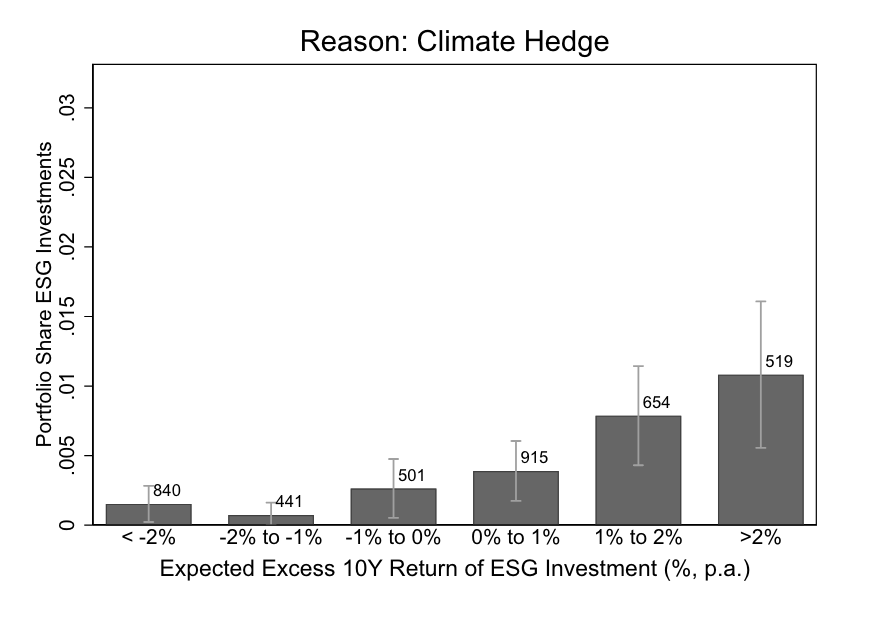 which says that there is a positive relation between expected excess ESG returns (x-axis) and the share of ESG holdings, conditional on investors who report the hedging of climate risk as their key ESG investment motive. So even when ESG investments are driven by hedging motives, financial return considerations play an important role. One important extension of the paper would be to disentangle E, S, and G. [paper link]
 - Martin Schneider showed how a capital tax on energy users that rises linearly with emission intensity is equivalent to a carbon tax on level of emissions. The intuition is that firms use fuel which generates emissions, and they choose the level of fuel jointly with capital to minimize cost.
- Jeff Wurgler presented a new paper on green bonds that introduces this concept of “additionality” — how much additional stuff a green bond does relative to an “ordinary” bond with the same issuer. It basically measures how fungible capital raised from green bonds is with respect to capital raised from ordinary bonds. One could also attempt to use this to summarize the greenwashing behavior of issuers, but one would require additional information on how green the original projects are.