Conference Recap: WAPFIN@Stern
September 2025
This entry pertains to the Workshop for Assistant Professors in Finance (WAPFIN) @ NYU Stern.
Introduction
For its 10-year anniversary, the conference broadened its focus. Originally designed to support women in the profession, the scope now includes all junior faculty. I presented on the second day, which was structured around fast-paced 20-minute sessions.
Day 1: Paper Sessions
- Pari Sastry (Wharton) presented *“The Insurance Protection Gap.” *I’ve seen several versions of this talk, but one detail stood out more sharply this time: homeowners’ insurance is purchased after the housing decision is made but before the mortgage closes. This sequencing makes it very difficult to adjust housing consumption after learning insurance premiums, though households can still adjust coverage or loan amounts.
- Antonio Coppola(Stanford) presented *“Financial Regulation and AI: A Faustian Bargain?” *This was a provocative paper asking whether high-dimensional predictive models can inform macroprudential policy. The theory centers on regulators’ model choice; empirics implement a predictive architecture. Coppola argued that graph neural nets are a natural representation for asset markets, which I thought was an interesting point. Audience discussion raised whether alternative tools, such as disclosure rules, could mitigate information asymmetry; the paper abstracts from these, but I do think they matter for policy translation.
- Taisiya Sikorskaya (Booth) presented “Sparse Portfolios and Benchmarking in Corporate Bond Markets.” The paper documents stylized facts on corporate bond benchmarks versus actual fund holdings, then develops a model that produces sparse equilibrium portfolios. It’s useful to think about which equity-market intuitions carry over to fixed income and which do not.
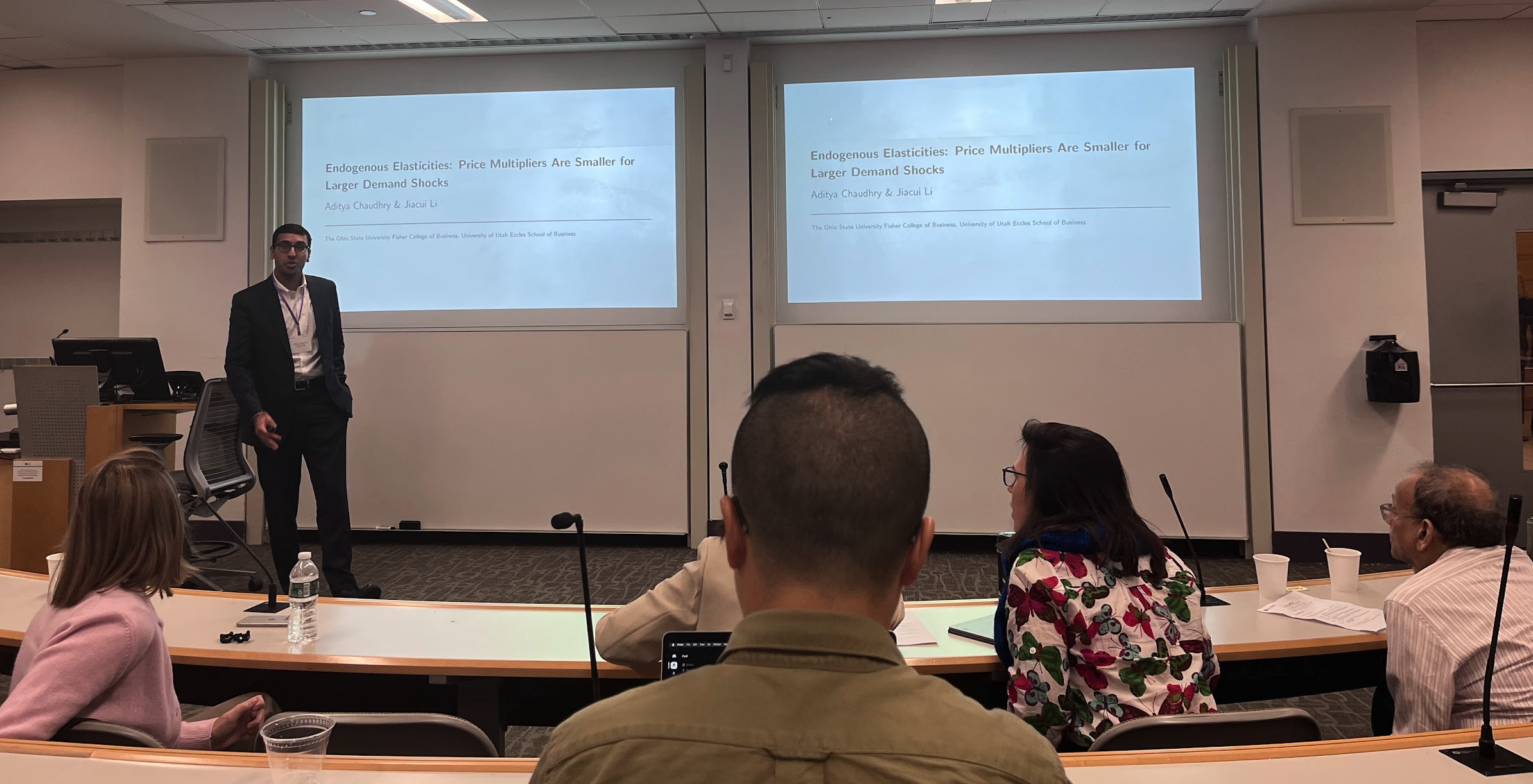
- Aditya Chaudhry (Ohio State) presented “Endogenous Elasticities: Price Multipliers Are Smaller for Larger Demand Shocks.” The basic idea is that multipliers are nonlinear in shock size. There were some discussions about the choice between parametric interaction terms and a non-parametric approach; the non-parametric seems the more natural baseline, since a linear model produces implausible behavior at large shocks.
- Juliane Begenau (Stanford) presented “Interest Rate Risk and Cross-Sectional Effects of Micro-Prudential Regulation.” The model joins banks’ portfolio choice (bonds vs loans) with funding choice (insured vs uninsured deposits), generating run risk. Given the striking behavior across the size distribution of banks, the authors naturally consider a size-dependent capital requirement, which is effective at reducing run risk.
Day 2: Lightning Sessions
- Manav Chaudhry (LSE) presented “The Long and Short of Price Responses: From Spreads to Levels.” The core point is that as spreads net out cross-asset spillovers, so we must be careful inferring about levels (which often we do).
- Kaushik Vasudevan (Purdue) presented “Policy by Committee.” I’d seen this at Columbia the week before. Discussion focused on look-ahead bias and what counts as a “model.” Amusingly, someone in the audience asked almost the exact question I had asked previously!
- Valeria Fedyk (ASU) presented “Is Love Blind? AI-Powered Trading with Emotional Dividends.” It featured a hedonic regression on NFTs, with a surprisingly high R². The residual is interpreted as “emotional dividends” — likely a lower bound since coefficients probably embed some of that too.
- Sergey Sarkisyan (OSU) presented “Digital Payments and Monetary Policy Transmission.” The paper uses Brazil’s Pix as the empirical setting. An important question, also brought up by the audience, is whether the key feature of digital payments simply lower cost or something else (e.g. high velocity of money)?
- Runjing Lu(Toronto) presented “Does Social Media Influence Entrepreneurship?” which uses Facebook’s Ivy League rollout as the empirical setting. The project was in the early stages, and there were lots of discussions about endogenous rollout decisions and disentangling peer effects from matching.
- Milena Wittwer (Columbia) presented “Imperfect Competition and Moral Hazard in Financial Markets.” The paper is about the interaction of two forces: (i) more competition lowers traders’ rents, but (ii) more competition also reduces price uncertainty, a new angle here. The balance of these forces determines whether moral hazard worsens or improves.
Takeaways
- The senior panel emphasized that being a good colleague is under-rated. Beyond research output, showing up for others — whether through feedback, teaching contributions, or informal support — was described as essential for long-term success. At first I thought this was obvious, since collegiality transcends jobs and fields, but perhaps in academia — where the incentive system tilts so heavily toward individual output — the reminder carries more weight.