What’s in a good (academic) seminar presentation?
While it is widely acknowledged that delivering a compelling seminar presentation can go a long way in finance and economics academia, concrete suggestions for improvement are surprisingly rare. In this post, I seek to fill this gap by exploring the key elements of an effective academic presentation in finance, drawing insights from some of the field’s best presenters.
Introduction
At the heart of academic culture lies the seminar, and the fields of economics and finance are no exception to this tradition. Most seminars in our field run for 1 to 1.5 hours, featuring real-time Q&A sessions that are as integral to the presentation as the talk itself. These questions also come in various forms and colors. Some seek clarification on specific points, while others ignite battles over the minutiae of empirical design or spark discussions about alternative approaches to the research question.
The ability to navigate these waters becomes increasingly crucial for success on the job market and for the academic’s reputation. Yet, most doctoral students (including myself from barely a year ago) find themselves in a challenging position, having little to no experience presenting in a formal seminar setting. While it’s widely acknowledged that delivering a compelling presentation is crucial for success in academia, concrete suggestions for improvement are surprisingly scarce.
This post aims to fill this gap in the resources available to early-career researchers. It may be particularly beneficial for non-native English speakers who, like myself, often face additional challenges in academic communication.
Great Presenters in Finance Academia
Let’s first talk about what makes a great finance seminar. Imagine that you’re sitting in a room and for an hour and a half, you’re not checking your phone, not daydreaming about your next meal, but actually engaged. The presenter is delivering economic insights one slide after another, the Q&A session feels like a stimulating debate rather than an academic cage match, and by the end, you actually remember the key takeaways.
A great presenter then is someone who can consistently deliver this unicorn of academic experiences. There are at least four researchers in financial economics, in my biased and non-peer-reviewed opinion, that i think serve as a good role model when it comes to delivering good seminars. Let me briefly describe who they are and what we can take away from their presentations.
Component #1: Cognitive Empathy
First is Bryan Kelly at Yale, who works with cutting-edge tools to study asset pricing topics. I think the presentation below at the 2024 Utah Winter Finance Conference is a good example (watch the first introduction of his slide deck):
What I think Bryan does exceptionally well is what I’d like to call “cognitive empathy,” (for lack of a better term that doesn’t sound like it came from a self-help book.) He has a great sense of what his audience knows, what they don’t know, and how to bridge that gap without making anyone feel like they should have paid more attention in their PhD courses. And his first slides are making sure that we are ready to understand the contributions of his paper.
This skill is of particular importance in the context of academic seminars, where contents tend to build cumulatively. It’s not uncommon for speakers to make unwarranted assumptions about their audience’s familiarity with certain concepts. They may casually reference terms or ideas, presuming a shared understanding, when in reality a significant portion of the room checks out.
John Shim is another great example — I had a chance to listen to him present a paper on market microstructure, and he knew exactly what people know and what people don’t know. Excellent presenter.
Component #2: Energy
The second researcher I’d like to discuss is Laura Veldkamp, my colleague at Columbia. One of the most memorable seminars I’ve attended is her keynote address at the 2024 MFA annual meeting. In addition to her ability to communicate complex ideas with clarity and enthusiasm, one defining characteristic of her presentations is “energy.”
I think high energy is useful for many reasons. First, it is infectious and serves as an effective antidote to the soporific effects of a post-lunch seminar. Second, it is authentic — faking enthusiasm for one’s research is challenging. High energy, when genuine, thus signals a deep-seated passion for the subject matter, which people appreciate.
There are some cases, however, in which high energy may backfire. In fact, there is a fine line between enthusiasm and alarmism, yet this line is not so obvious to the presenter. Emphatically insisting on the urgency of your research topic may backfire if the audience doesn’t share your level of concern. In addition, different academic cultures may have varying tolerances for high-energy presentations. What invigorates a seminar room in one institution might be perceived as overly aggressive or informal in another.
So high energy can be a powerful asset in presentations, but it requires careful calibration. One must strike a balance between engaging the audience and avoiding the appearance of having consumed an entire pot of espresso before the seminar. The goal is to energize your audience, not exhaust them.
Component #3: Clarity
The third researcher I’d like to discuss is Lubos Pastor. He is well known for being eloquent and clear in his communication, and I’ve seen it multiple times during my time at Chicago Booth. There’s a sense of beauty in watching him distill complex financial concepts into digestible narratives.
Of all the presentation components that we’ve discussed so far, Lubos’ clarity and eloquence may be the most elusive to emulate. One reason is that to explain complex ideas simply, one must understand them at a level that borders on the intuitive. It’s the difference between reciting a recipe and being able to cook the dish blindfolded.
It also requires a keen sense of your audience’s perspective. What seems clear to you, the expert who’s been marinating in these ideas for months or years, may be as opaque to your listeners. Bridging this gap requires a type of cognitive empathy that’s difficult to cultivate.
Another reason could simply be that we lack the courage to be simple. In academia, there’s often a temptation to demonstrate one’s intellect through complexity. And resisting this urge is by no means an easy task, especially in the absence of a long CV.
Component #4: Crowd Control
The final researcher I’d like to discuss is Amir Sufi, who exemplifies the virtue of “crowd control” — the ability to masterfully manage the seminar room dynamics, particularly during Q&A sessions. The latter third of the video shows Amir engaging with the audience.
In my view, what sets Amir apart is his remarkable ability to maintain control of his narrative while simultaneously engaging with audience questions. His approach to handling interruptions is particularly instructive. Rather than allowing questions to derail his presentation’s flow, he demonstrates a keen sense of when to address a question immediately and when to defer it to a more appropriate moment.
The art of crowd control extends beyond just managing interruptions. It includes the ability to read the room’s energy, anticipate potential concerns, and address them proactively. When faced with challenging questions, Amir exhibits what I consider to be the gold standard: he acknowledges the validity of the concern, connects it to his broader argument, and uses it as a springboard to strengthen his paper’s narrative rather than treating it as an attack to be defended against.
Of course this requires a delicate balance — being too controlling can stifle valuable discussion and make you appear defensive, while being too accommodating can lead to losing control of your seminar’s narrative.
Specific Tips for Presentation Delivery
- Do your homework. Understanding who will be in your audience can significantly enhance the effectiveness of your presentation.
- Look up the research interests and recent publications of the department members who are likely to attend. Based on the department’s research bent, you might choose to elaborate more on certain aspects of your work.
- Different departments may have varying levels of familiarity with certain methodologies or subfields. Adjust your presentation accordingly.
- As you’ve noted, it’s good practice to recognize the work of those in the room.
“This paper builds on a large literature, to which many of you have contributed…”
- Prepare for specific questions: If you know that a particular faculty member has written extensively on a related topic, be ready for in-depth questions in that area.
- Pause. Pause when you said something that you want the audience to absorb. This is a high Sharpe ratio way of improving the clarity and impact of your message.
Taking the time to give a single convincing answer is much better than a rushed answer, which often engenders a long confused debate — slowing down is good. Pausing makes you sound profound. Answering before the person finished his question is rude. (Lasse Pedersen)
- Use pauses to build suspense.
“Now you may think that the treatment effect may not be large. [PAUSE] But it turns out, [PAUSE] that the effect is an order of magnitude larger than previously thought.”
“The main contribution of our paper [PAUSE] is a new measure of systemic risk [PAUSE] that accounts for network effects in the banking sector.”
- Pause after stating a crucial finding or insight.
“We find that ESG factors significantly impact stock returns [PAUSE] but only during periods of market stress.”
- Use pauses to separate elements of a multi-faceted concept.
“The pricing kernel depends on three factors: [PAUSE] consumption growth, [PAUSE] volatility, [PAUSE] and the variance risk premium.”
- Be humble. Everyone is smart in academia and has a PhD, and humility can go a long way. It makes you more approachable, encouraging questions and dialogue. It demonstrates that you’re open to feedback and constructive criticism
Now, if you are not used to being humble or have a bloated ego, here are some phrases you can use to constrain yourself for the duration of the seminar:
- Be upfront about the limitations of your work.
“While our model captures many key features of the market, it admittedly abstracts from some real-world complexities.”
“The identification strategy here relies on some strong assumptions. We’ve done our best to defend these, but we’re very open to suggestions for improvement”
- Show that you value the audience’s insights.
“I’m particularly excited to hear your thoughts on this, as I know many of you have extensive experience in this area.”
- If you’re asked a question you can’t answer, be honest about it. Think out loud.
“That’s an excellent question. To be honest, I hadn’t considered that angle. But let me share my immediate thoughts.”
- Invite clarification
“I realize this is a complex point. Please feel free to stop me if anything needs further explanation.”
- Don’t try to “stand out” by deviating from the accepted academic norms.
- You’re not teaching MBAs, so don’t treat the audience like MBAs.
“So how do you think investor sentiment might affect stock returns? Anyone want to venture a guess?”
Audience: “How does your model account for liquidity risk?”
””That’s an interesting question. Before I answer, let me ask you this: what do you think are the key components of liquidity risk in our setting? [Waits for response] Okay, and how might those components interact with our main variables of interest? [Waits again] Now, given those interactions, how would you expect liquidity risk to affect our results?”
- Don’t over-address the person’s name.
“John, that’s an excellent question. You see, John, our model accounts for this by… And to address the second part of your question, John,…”
Specific Tips for Answering Q&A
- If you’re asked to explain something, deliver a dumbed down version or use examples. For example, instead of saying:
“Flows are responding to some common factors; at the same time, the portfolio weights are also functions of these common factors.”
instead say:
“Let’s say that there’s a new AI breakthrough that makes everyone more bullish on tech. That directly raises price of tech stocks. At same time, that probs also drives flows into tech funds because people want more exposure to tech.”
- If you need more time to answer the question, simply rephrase it for the rest of the audience. But you can’t do this too many times.
“Okay just to make sure we are on the same page, the question is about whether varying degrees of investor sophistication could affect our inferences about market efficiency. This is an important question and let me address it by…”
- It’s useful to first say what the short answer is and then describe the answer is.
“The short answer is “No” with a few caveats. Let me explain. …”
- Replace UMM’s, AHH’s, and SOO’s with SILENCE.
- Useful case studies:
- When someone in the seminar is clearly wrong but the person is unwilling to budge:
“I appreciate your perspective on this. I do agree with you that ___. My guess is that implicitly behind our different conclusions are differences in assumptions, but perhaps we could discuss this further after the seminar?
- What do you do in a situation where someone asks an imprecise question, and you ask them to clarify, and they are unable or unwilling to do so?
“Okay, I just wanted to make sure I understood your question so that I can address it properly. Let me attempt to rephrase it based on my understanding. If this is what you had in mind, let me answer it; if not, let’s continue after the talk.”
- When someone keeps interrupting with tangential points:
“That’s an interesting point, and it relates to some broader issues in the field. To keep us on track, let me finish presenting the core results, and we can explore these related ideas during the Q&A or afterwards.”
- When an audience member dominates the Q&A and you want to involve others
“Thanks for those insights. To make sure we hear from others as well, let’s take one or two more questions from the audience before circling back.”
Other Useful Tips
- The two most important things in a talk are (i) you are articulate and clear so people get everything, and (ii) you show your enthusiasm. If you are not enthusiastic, how can you expect anyone else to be? (Lasse Pedersen)
- Stopping a little early is fine, but try not to be more than 10 minutes early. Never go over time. (Lasse Pedersen)
- Make transitions after every slide — some short, others longer. Make the transition before you put on the next slide, which ensures that the focus is on you. Look up and engage the audience. (Lasse Pedersen)
“I have shown you how the model works. Now we ware going to solve for the equilibrium.”
- Drawing Questions. Draw questions about the marginal contribution. Perhaps even invite questions, when they are likely to concern your contribution. Arguing about your contribution, convincing the audience about it, is a good way to spend time. Do not draw questions that are not about contribution. If you keep getting irrelevant questions, think about what you are doing wrong. If you find yourself arguing about what some old paper really did, then you are doing something wrong.
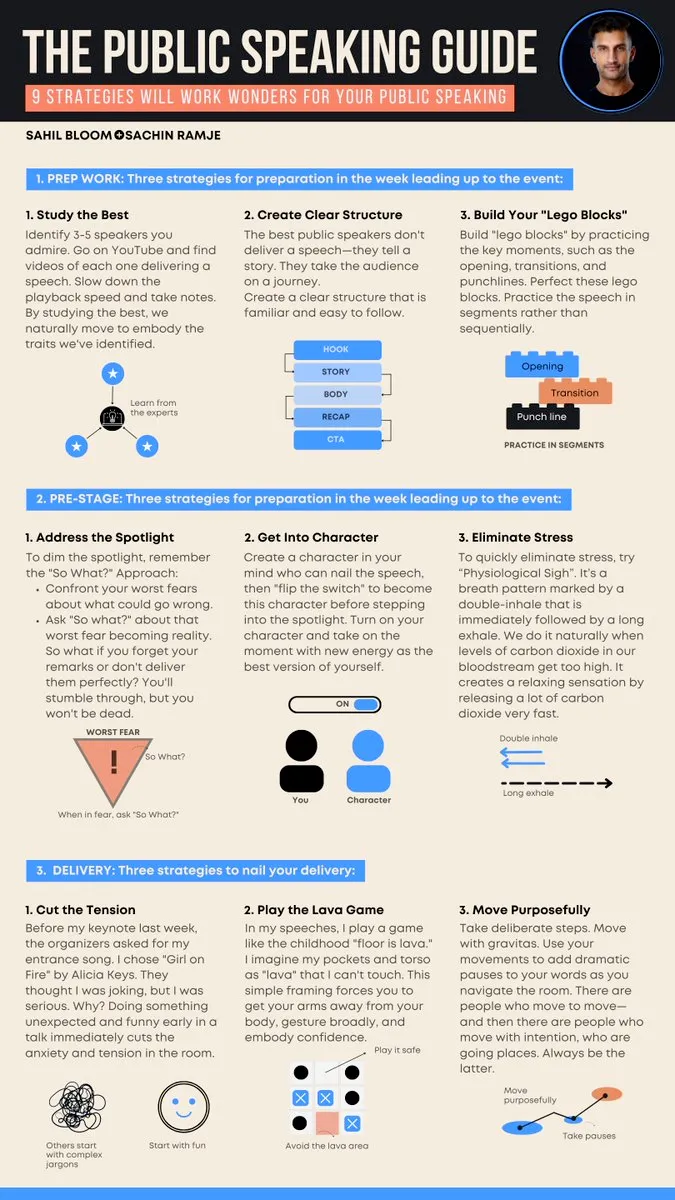
Check out this public speaking guide bySahil Bloom.
Presentations tips by Anthony Zhang
Your paper is a circle. The circle marks the territory you want to claim: your paper’s contribution. Your goal is to:
- Draw a moderate-sized circle
Defend your circle
There is a tradeoff. Draw too big a circle, and you can’t defend it. Draw too small a circle, and nobody cares about your paper. You should be very clear to yourself what the circle is. When answering questions, you can refer to your circle — If the question doesn’t infringe on the territory you want to claim, don’t challenge it. Accept it. “That’s right/possible/etc but doesn’t affect the main contribution of your paper” — One common mistake is to push back too aggressively against critiques, which makes you look combative/like you’re overclaiming/etc. There are many punches you can roll with: questions you can take a step back with without losing much territory to — What is important, however, is to justify why you can accept the question/comment/critique, and the main point of your paper still stands. You then make the questioner look good without losing your circle, so it’s a win-win — The opposite mistake also happens: you can take too many punches, being too nice and acknowledging too much. “Actually I wouldn’t go as far as to say my paper implies that”. Say this too many times and you have no circle left, and your paper’s contribution is too small — You cannot qualify everything and agree with everything. But you can be strategic about what needs to be defended, and focus your defenses on the circle you need to defend for your paper to have value — Do not draw a circle and then wander outside it, allowing questions to bring you off to interesting but unrelated tangents. Those are other people’s circles. “That’s interesting but not the topic of my paper” or something along those lines is fine — Your goal is not (primarily) to look smart, your goal is to defend your circle, and attempts to bring you outside the circle with unrelated or vaguely related questions limit your ability to defend your circle
How to articulate your thoughts by Matt Huang (video link)
- Begin “articulate” means (i) delivering fluently, and (ii) coherently.
- In deciding what you say:
- Make sure to understand the topic
- Clarify what the goal is for the talk
- Find the fastest path to explain
- Anticipate questions and incorporate answers in the talk
- In deciding how to say:
- Reduce mental bandwidth required for listener by:
— Taking out flowery language
— Employing a top-down approach (state main idea at the beginning) - Storytelling (show not tell) with detail
- Dial up energy level to engage the audience
- Reduce mental bandwidth required for listener by:
Useful Phrases
“Thank you for your feedback. I will take it into consideration. I have a different perspective on this subject.”
“Thank you for your thoughts on this. I’d be happy to talk more with you after the Q&A or by email”
“I’m glad you asked that question.”