Financial Approach to Environmental Sustainability
The past few years have seen many actors in the financial system take sustainability into account in their decision-making. In this post, I paint a broad picture of the related efforts and how they interact with one another.
Sustainable Investing in Equity Markets
Let’s first start with discussing sustainable investing in equity markets, often summarized as Environment, Social, and Governance (ESG). The main idea is that investors should consider not only financial objectives but also other criteria, and it comes in two main forms:
- Engagement: Investors with green preferences will hold shares in brown firms and engage with the owners of the firm to make the firm greener.
- Divestment: Investors with green preferences will hold shares in green firms so that cost of capital of green firms decreases relative to that of brown firms, thereby stimulating take-up of green projects relative to brown projects.
The verdict on which strategy is more effective — or whether they are effective at all — is still unclear. Papers like Broccardo, Hart and Zingales (2021) or Edmans, Levit, and Schneemeier (2021) examine this issue theoretically, but the empirical research is quite scant.
One of the major issues in sustainable equity investing is identifying which firms are green and which firms are brown. The first layer of complication, which is often overlooked in the discussion regarding ESG, is determining what really matters for investor demand. Is it how much carbon emissions they are emitting today? Is it how much they are willing to curtail? Is it how good they are at reducing carbon emissions?
The second layer of complication, which has received relatively more attention is actually measuring these dimensions of firm operations. For example, Berg, Kolbel, and Rigobon (2022) show that the major ESG ratings lack internal consistency.
From an academic’s perspective, there is a final layer of complication, in which we do not have a good understanding of what investors pay attention to in deciding sustainable capital allocation decisions. Fortunately, with granular holdings data and recent progresses in demand estimation techniques, this complication is easier to address than the preceding two.
Issuance of Corporate Green Bonds
On the corporate financing side, there has been a recent development in green bonds. There are several slightly different structures, but the broad idea is that the firm is able to raise money more cheaply due its commitment to use the proceeds to finance sustainable projects or because its coupon structures are explicitly linked to sustainability targets.
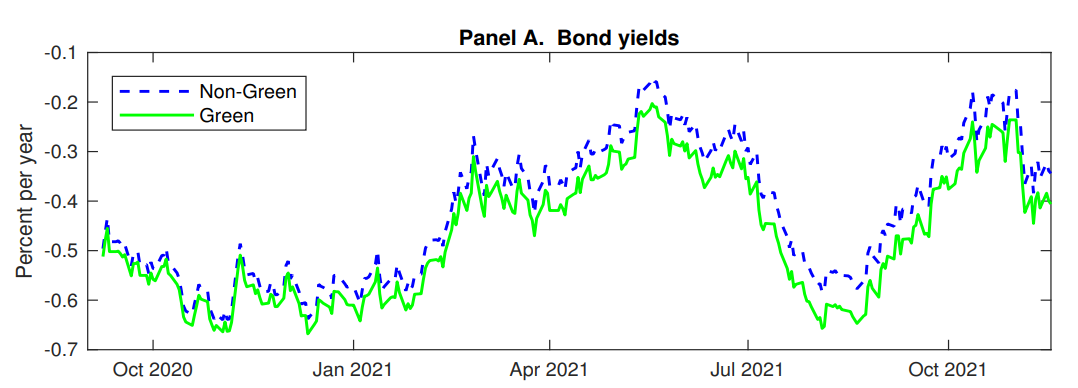
The first question to ask is whether the commitment to sustainability embedded in these bonds enable cheaper financing. Generally, the answer seems to be yes.
- Caramichael and Rapp (2022) find that green bonds on average have a yield spread that is 8 basis points lower relative to conventional bonds.
- Pastor, Stambaugh, and Taylor (2022) show that green bonds issued by the German government on average have a yield spread that is 4.6 basis points lower relative to its twin.
- Flammer (2021) also finds a side benefit of issuing green bonds: the stock market responds positively to the issuance of green bonds.
The second question to ask is who issues these green projects. Taking the green bond issuance decision seriously is quite important because it highlights the types of projects that are taken in equilibrium. To see this, let’s think about both the best-case and the worst-case scenario for firms that are choosing between a green project and a brown project:
- Best-case: The cost of financing differential thanks to the greenium is high enough so that now the present value of investing in a green project is higher than an alternative brown project, while in the absence of the green bond it would not have been the case.
- Worst-case: The greenium is not large enough, and as a result firms that would have chosen the green project anyways issue green bonds and finance the project more cheaply, while firms that would have chosen the brown project do not issue these bonds and are unaffected by green bonds.
So who issues these bonds? Flammer (2021) looks at the period 2013 to 2018 and finds that the issuance is concentrated in financial companies and utilities, power generation, and renewable energy:
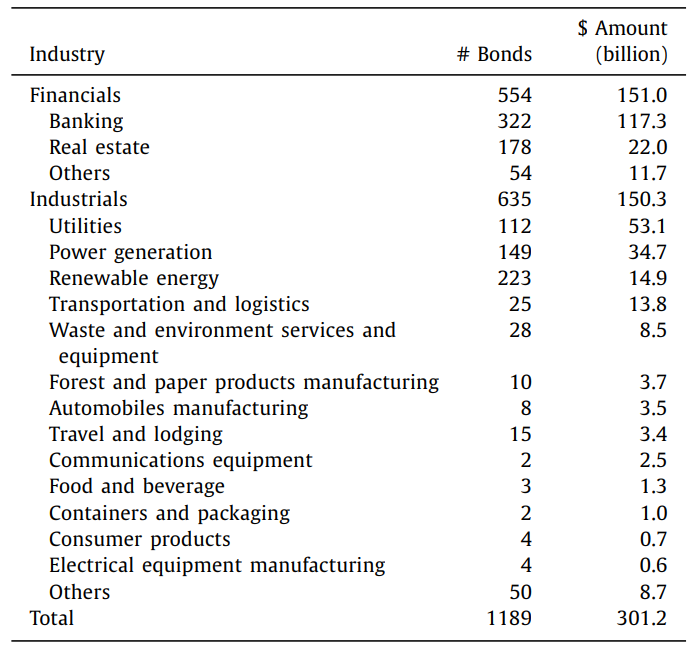
Across the board, we do not see many brown firms (e.g. oil companies) issuing these green corporate bonds. In fact, about half of the issuance is concentrated among financial firms that likely have projects not directly related to environmental sustainability.
Sovereign Green Bonds
Governments have also been issuing sovereign green bonds, the proceeds of which are assigned to particular sustainability uses. Daniel C. Hardy provides a recent overview of this issue.
“Green” Central Banking
At a broad scale, one major issue is whether concerns about sustainability should be explicitly or implicitly part of the mandate of central banks, in addition to concerns about inflation and growth / unemployment. One argument can be made that climate change will affect the ability of central banks to achieve their mandates. On the other hand, even the it is pertinent, one should ask whether central banks have the right toolkit to address it.
- For example, Lars Hansen argues that monetary policy is a weak substitute for fiscal policy, which is far better suited to address climate change through tools such as carbon taxation and investment in green technologies
So what specifically can central banks do? In June 2021, the Network for Greening the Financial System (NGFS) outlined nine specific measures that central banks can take:
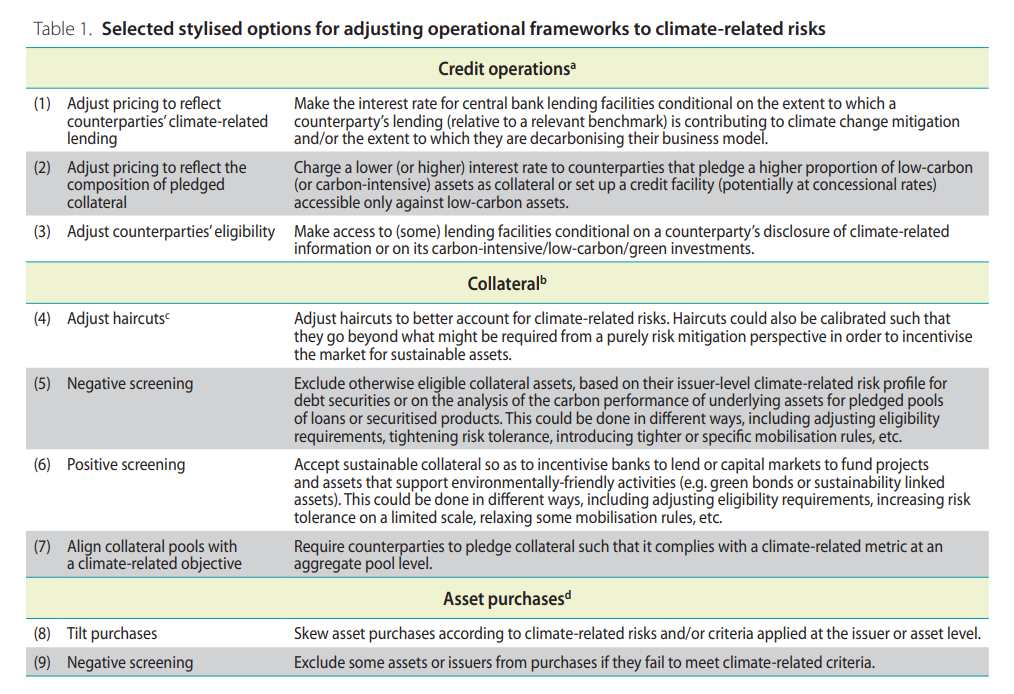
In monetary policy, most of the discussions surround the implementation of green asset purchases, which indeed allows for a more targeted approach than changing the policy rates. Recently, Papoutsi, Piazzesi, and Schneider (2022) argues that the ECB’s unconventional monetary policy tends to give greater weight to sectors with a higher share of the carbon emissions.
Bank of Japan has a slightly different approach via what they call a climate response financing operation. In this scheme, the BoJ provides funds to banks against investment or loans they make to address climate change based on their own judgment, instead of the direct purchase of green bonds. In a similar vein, the ECB and the Bank of China provides a preferential treatment of green bonds, the macroeconomic impact of which has been studied in Giovanardi, Kaldorf, Radke, and Wicknig (2022).
In financial stability regulation, there recently has been calls to incorporate environmental risk into banking regulations, a.k.a. green capital requirements. For example, central banks may lower the capital requirement for greener investments. Oehmke and Opp (2022) study theoretically the effects of green capital requirements and highlights the potential limitations of this approach. Climate stress tests have already been launched in the ECB, which looks like a standard bank stress test but focusing on climate-related assets and not the entire balance sheet. For the US, Jung, Engle, and Berner (2022) suggest a slightly different approach that focuses on measuring the effect of climate risk on financial stability, through its effect on asset prices.
Bank Lending
For banks, the obvious channel is to incorporate sustainability considerations is in their lending decisions. There is some empirical evidence suggesting that the banks are already actively doing this:
- Reghezza et al. (2021) show that after the Paris Agreement, European banks reallocated credit away from polluting firms.
- Kacperczyk and Peydró (2022) show that firms with higher carbon footprint previously borrowing from committed banks subsequently receive less bank credit.
- Mueller and Sfrappini (2022) show that banks change their credit allocation decisions in response to climate-related regulatory developments, and importantly the response differs across the US and Europe.
The issues that we discussed regarding investors in sustainable equity investing are also pertinent here. How should the lending decisions be made, based on what criteria? How far is the current practice from the “optimal” equilibrium allocation of bank capital?
Insurance Companies
Insurers are an interesting group of the financial sector since they have been mutualizing and managing climate risk before the demand for sustainability-linked decisions. As I describe in one of my papers, homeowners insurance already protects households against major forms of climate-induced events.
So in addition to pooling risk and providing insurance at (hopefully) low markup, what else can insurers do with respect to sustainability?
- Invest in green assets: As is well known, insurers are the largest investor in the corporate bonds market. If their demand meaningfully reflects sustainability, it can generate meaningful price pressure both in the primary and the secondary market.
- Screen policyholders: Insurers may decide not to underwrite policies for firms that fail on the sustainability metric.
- Actively manage risks: Insurers can take an active role by providing incentives for more sustainable practices. For example, they can encourage safer practices by policyholders using the promise of lower premiums. In general, the insurance companies lose from greater severity and frequency of climate disasters, so it is in their best interests to invest and reduce the quantity of risk.
Role of Retail Investors
The past years of Meme stock saga have shown that collectively retail investors can be an important source of demand for specific securities. As a result, even if institutions collectively have a higher demand for green assets, the retail investor demand may undo this price pressure by taking the other side, thereby mitigating the cost of capital channel of sustainable investing.
In equity markets, there is mixed evidence so far:
- Hartzmark and Sussman (2019) looks at the fund flows to US mutual funds and provide causal evidence that investors marketwide value sustainability.
- Briere and Ramelli (2021) show that the offering of responsible investment options
significantly increase the propensity of individual investors to take risks on financial markets by investing in equity products. - Moss, Naughton, and Wang (2020) look at the security positions on Robinhood and find that ESG disclosures are irrelevant to retail investors’ portfolio allocation decisions.